
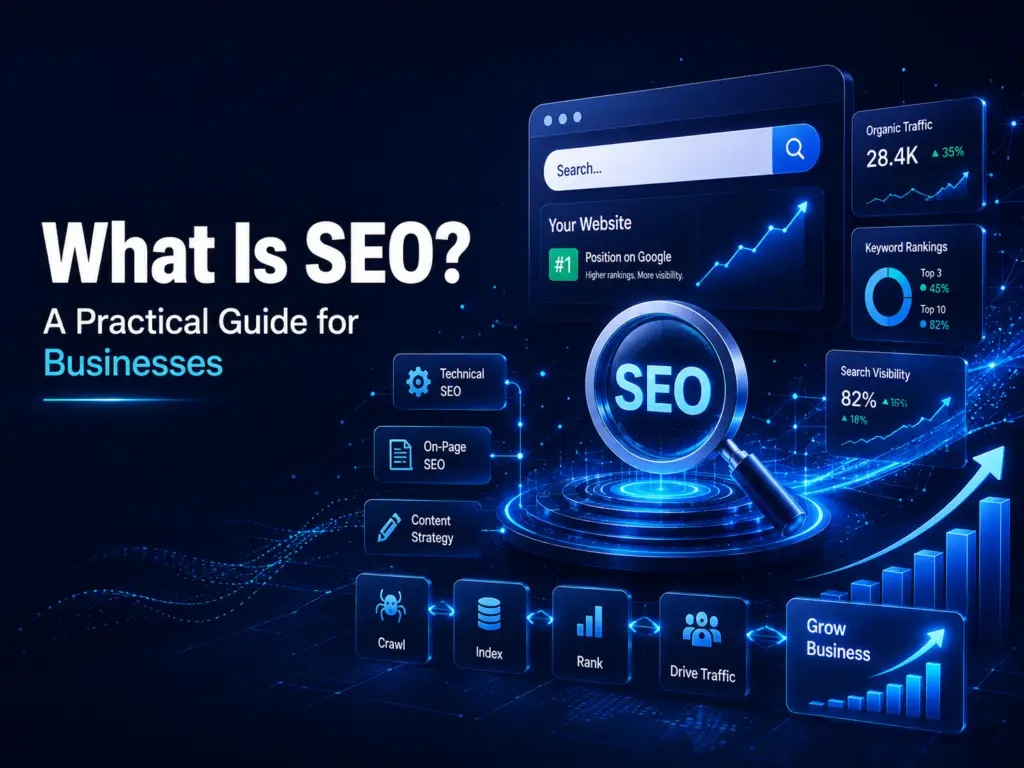
If you own a business and you’ve been told over and over again that you “need SEO,” you’re probably wondering: what is SEO, really, and why does everyone treat it like a magic switch for growth?
You’re not alone. Almost every business owner we talk to at PerformXEngine has heard the term thrown around in meetings, ads, and by well-meaning marketing vendors, but very few people have had it explained in plain, practical language. So before you spend another rupee or dollar on marketing, let’s answer the one question that matters most: what is SEO, and how can it actually help your business grow?
This blog is your starting point. It’s a pillar guide, which means we’re covering every major part of SEO briefly here, and in the coming weeks, we’ll publish detailed guides on each subtopic linked from this page. Think of this as your map before you start the journey.
What Is SEO? The Simple Definition
Let’s start with the basics. What is SEO? SEO stands for Search Engine Optimization. In the simplest terms, it is the practice of improving your website so that it ranks higher on search engines like Google, Bing, or Yahoo when people search for products, services, or information related to your business.
If someone searches “best digital marketing agency near me” or “affordable web design services,” SEO is what determines whether your business shows up on page one or gets buried on page five, where almost nobody ever scrolls.
So, in short: the definition of SEO is the combination of strategies, techniques, and best practices used to increase a website’s visibility in organic (non-paid) search engine results.
Why Search Engine Optimization Actually Matters for Your Business
Now that we’ve covered the definition, let’s talk about why this matters from a business perspective, because knowing what SEO stands for isn’t enough. You need to understand why it affects your bottom line.
Here’s the reality: over 90% of online experiences begin with a search engine. Whether your customers are looking for a plumber, a SaaS tool, a clothing brand, or a consultant, they are almost always starting with a Google search. If your website isn’t optimized, you are invisible at the exact moment your potential customer is ready to buy.
That’s what search engine optimization solves. It’s not about tricking Google, it’s about making your website genuinely easier to find, easier to understand, and more trustworthy in the eyes of both search engines and real human visitors.
For a business owner, this translates into:
- More free, organic traffic (without paying for every click)
- Higher quality leads who are already searching for what you offer
- Long-term brand visibility and credibility
- A better return on investment compared to many paid channels
Meet the Person Behind the Strategy: What Is an SEO?
You may have also come across the phrase “what is an SEO” while researching, often used to describe the person or specialist who performs this work, rather than the practice itself.
An SEO (short for “SEO specialist” or “SEO expert”) is a professional who plans, executes, and manages search engine optimization strategies for a website. Their job includes researching keywords, improving website structure, creating optimized content, building backlinks, and analyzing performance data to keep improving rankings over time.
Many business owners try to handle this themselves in the early stages, and that’s completely fine when you’re just starting out. But as competition grows, most businesses eventually work with either an in-house specialist or a trusted digital marketing agency (like PerformXEngine) to manage this consistently, since SEO is not a one-time task. It’s an ongoing process.
How Search Engines Actually Work Behind the Scenes
Let’s go a level deeper into what is SEO and how it works in the background. To understand this, you need to understand how search engines actually operate. Google and other search engines use automated programs called “crawlers” or “bots” to scan billions of web pages across the internet. This process is called crawling.
Once a page is crawled, it gets stored in a massive database. This is called indexing. Finally, when someone types a search query, the search engine’s algorithm scans its index and displays the most relevant, trustworthy, and useful pages in what’s called ranking.
Here’s what is SEO and how it works, summarized in three steps:
- Crawling – Search engines discover your website and its pages.
- Indexing – Your pages are stored and categorized based on their content.
- Ranking – When someone searches a relevant term, the algorithm decides where your page appears in the results.
SEO is essentially the practice of optimizing each of these three stages, making sure your site is easy to crawl, properly indexed, and structured in a way that convinces the algorithm your page deserves to rank higher than your competitors.
The 5 Building Blocks of a Complete SEO Strategy
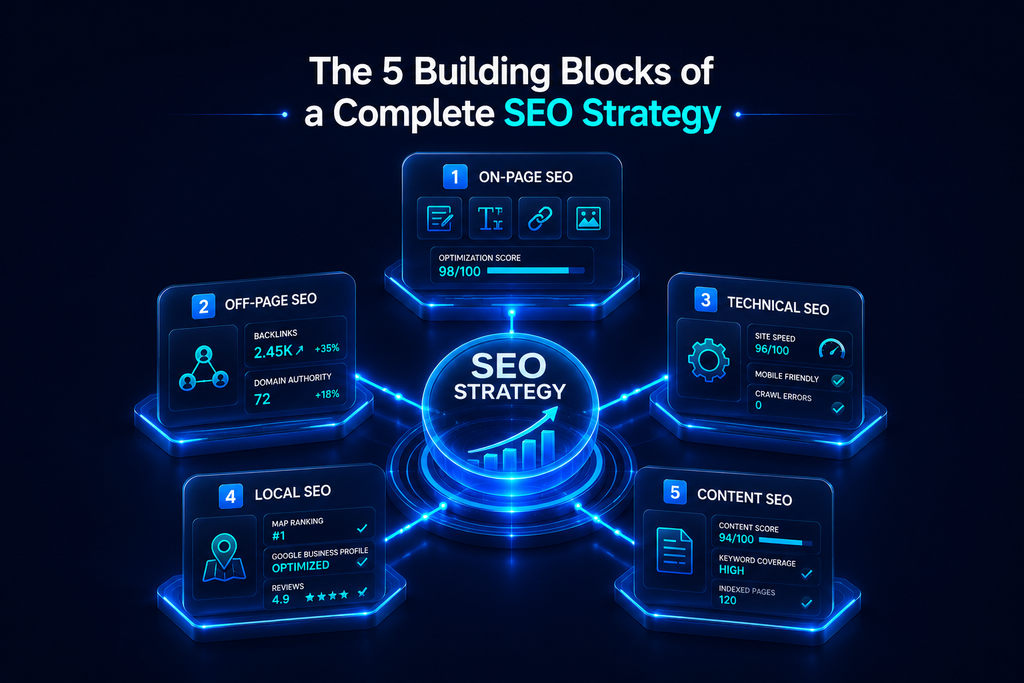
Since this is a pillar page, we won’t go deep into each of these. We’ll cover them in dedicated blogs soon. But here’s a short overview of the major components that make up a complete SEO strategy.
1. On-Page SEO
This refers to everything you optimize directly on your website, including page titles, meta descriptions, header tags, content quality, keyword usage, internal linking, and image optimization. On-page SEO makes it easier for search engines to understand what each page is about.
2. Off-Page SEO
Off-page SEO includes actions taken outside your website to build authority, primarily backlinks (other websites linking to yours), social signals, brand mentions, and influencer or PR outreach. The more reputable websites that link to you, the more trustworthy your site appears to search engines.
3. Technical SEO
Technical SEO focuses on the backend health of your website, including site speed, mobile-friendliness, secure HTTPS connections, clean URL structures, XML sitemaps, and fixing crawl errors. Even the best content won’t rank if your website is technically broken.
4. Local SEO
If you run a local business, such as a clinic, restaurant, salon, or service-based company, local SEO helps you appear in “near me” searches and Google Maps results. This includes optimizing your Google Business Profile, local citations, and location-specific keywords.
5. Content SEO
Content is the fuel behind SEO. Creating helpful, keyword-optimized, and well-structured content (like this very blog) is what gives search engines a reason to rank your pages in the first place.
Not Just for Tech Companies: Why Every Business Needs SEO
A common misconception is that SEO is only for “tech companies” or e-commerce brands. In reality, whether you run a local bakery, a law firm, a real estate agency, or a B2B software company, your potential customers are searching online before making a decision.
If you’re still wondering how this applies to your specific business, here’s the honest answer: SEO is the digital equivalent of having a well-located storefront on the busiest street in town, except the “street” is Google, and the “traffic” is intent-driven customers actively looking for what you sell.
Businesses that invest in SEO early tend to build a compounding advantage. Unlike paid ads, which stop generating traffic the moment you stop paying, good SEO continues to bring in visitors, leads, and sales for months or years after the initial work is done.
SEO Myths That Are Costing Business Owners Time and Money
Before we wrap up this guide, let’s clear up a few misunderstandings that often confuse people trying to understand the definition of SEO:
- “SEO gives instant results.” In reality, SEO is a mid-to-long-term strategy. Most businesses start seeing meaningful movement in 3–6 months.
- “SEO is a one-time task.” Search engines constantly update their algorithms, so SEO requires ongoing optimization and monitoring.
- “More keywords = better ranking.” Keyword stuffing is outdated and can actually hurt your rankings. Natural, relevant keyword usage always performs better.
- “SEO is only about Google.” While Google dominates, SEO principles also apply to Bing, YouTube, Amazon, and other search-driven platforms.
So, What Is SEO for Your Business, Really?
So, circling back to where we started: what is SEO? At its core, it’s the ongoing process of making your website more visible, more useful, and more trustworthy so that the right customers can find you exactly when they’re searching for what you offer.
For business owners, SEO isn’t a technical checkbox. It’s a long-term growth channel that builds credibility, drives consistent traffic, and reduces your dependency on paid advertising over time.
This guide covered the definition of SEO, the role of an SEO specialist, how search engines work, and the major pillars that make up a complete strategy, but this is just the foundation. In our upcoming cluster blogs, we’ll break down each of these topics, including on-page SEO, technical SEO, local SEO, link building, and keyword research, in much greater detail.
If you’re a business owner who’s serious about growing your online visibility but doesn’t have the time or in-house expertise to manage it all, that’s exactly where a dedicated digital marketing partner like Perform X Engine can help, turning this foundational understanding of SEO into a real, measurable growth strategy for your business.