
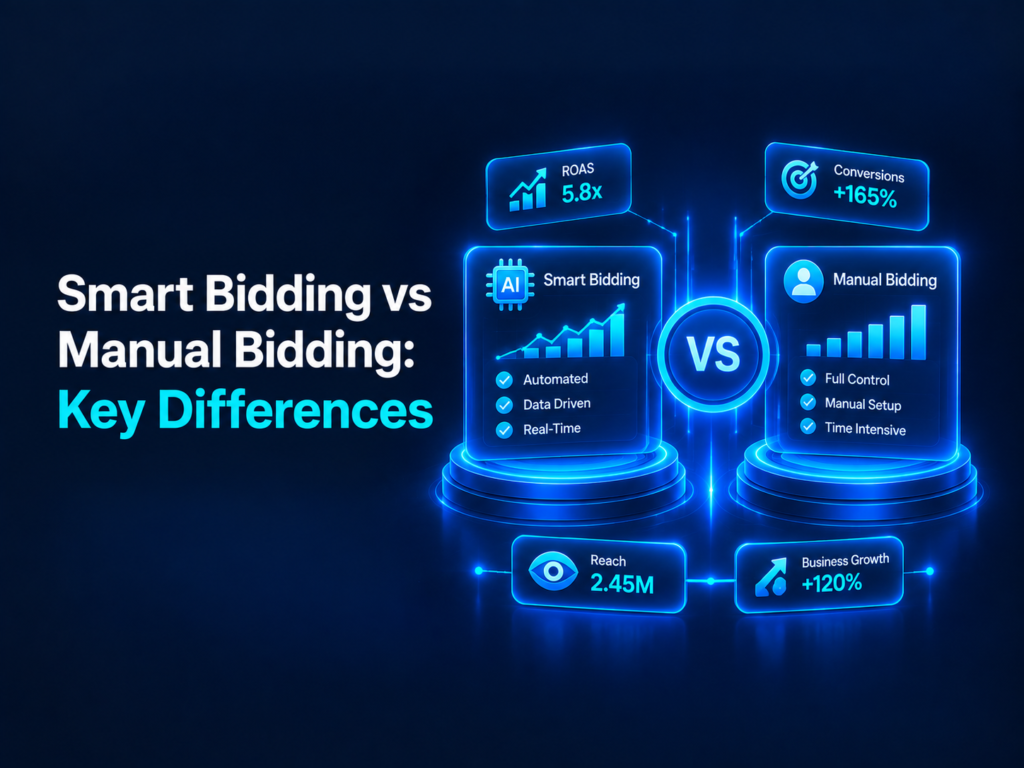
If you have ever set up a Google Ads campaign, you have run into one big decision early on: should you let Google’s system control your bids automatically, or should you set and adjust every bid yourself? This is the heart of the smart bidding vs manual bidding debate, and it is one of the most common questions we hear at Perform X Engine.
Both approaches can work well, but they work in very different ways, and choosing the wrong one for your situation can waste your budget or slow down your results. In this guide, we will explain everything about smart bidding and manual bidding in simple, plain language. We will cover how each one actually works, the real pros and cons of both, and exactly how to decide which approach is right for your business right now.
By the end of this blog, you will understand this topic clearly enough to make a confident, informed decision for your own Google Ads campaigns.
What Is Manual Bidding?
Let’s start with manual bidding, since it is the original, simpler approach.
Manual bidding means you, the advertiser, personally set the maximum amount you are willing to pay for a click on each keyword or ad group inside your Google Ads account. Google will never bid higher than the number you set, giving you full, direct control over your spending at the keyword level.
With manual bidding, if you notice a keyword performing really well, you can increase its bid yourself. If a keyword is wasting money, you can lower or pause it immediately. Every single decision stays in your hands.
What Is Smart Bidding?
Now let’s look at the other side of this comparison.
Smart bidding is Google’s term for a set of automated bidding strategies that use machine learning to set your bids for you, in real time, for every single auction. Instead of you deciding the bid manually, Google’s system studies hundreds of signals, like device type, location, time of day, past user behavior, and much more, to predict how likely each individual auction is to lead to a conversion, and it adjusts your bid accordingly.
Common smart bidding strategies include Target CPA, Target ROAS, Maximize Conversions, and Maximize Conversion Value. Each one automates your bidding toward a specific goal, whether that is getting more conversions, hitting a certain cost per acquisition, or reaching a specific return on ad spend.
Smart Bidding vs Manual Bidding: The Core Difference
At its heart, the smart bidding vs manual bidding comparison comes down to one simple question: who is actually setting the bid for each auction, a human or a machine?
- Manual bidding puts a person in control, using judgment, experience, and direct observation to set and adjust bids.
- Smart bidding puts Google’s machine learning system in control, using massive amounts of real-time data that no human could realistically process on their own.
Neither approach is automatically “better” in every single situation. The right choice depends on your account’s data history, your available time, your goals, and how much control you personally want to keep.
How Manual Bidding Actually Works
With manual bidding, you set a maximum cost per click for each keyword or ad group directly inside your Google Ads account. From there, it is up to you to monitor performance regularly and make adjustments based on what you observe.
For example, if a keyword is bringing in lots of conversions at a low cost, you might manually raise its bid to try and get even more traffic from it. If another keyword is spending money without producing results, you might lower its bid or pause it completely.
This hands-on process requires ongoing attention. The more keywords and campaigns you manage, the more time manual bidding realistically takes to manage well.
How Smart Bidding Actually Works
Smart bidding removes that manual, keyword by keyword decision-making and replaces it with an automated system. When you choose a smart bidding strategy, you are essentially telling Google, “Here is my overall goal, now use your data and machine learning to find the best bid for every single auction.”
For example, with Target CPA smart bidding, you tell Google roughly how much you are willing to pay for each conversion, and the system automatically raises or lowers bids across thousands of auctions to try and hit that average target, all without you touching individual keyword bids yourself.
This process relies heavily on historical conversion data. The more solid conversion data your account has, the better smart bidding tends to perform, since the machine learning system needs real patterns to learn from.
Pros and Cons of Manual Bidding
Pros of Manual Bidding
- Full control: You decide exactly what happens with every keyword bid.
- Great for learning: Beginners can learn a lot about how their account behaves by manually testing and adjusting bids themselves.
- Useful for new accounts: Without enough conversion history, manual bidding can be more reliable than smart bidding strategies that need data to work well.
- Easier to catch mistakes quickly: Since you are watching closely, unusual spending patterns can sometimes be spotted and fixed faster.
Cons of Manual Bidding
- Time consuming: Managing bids manually across many keywords and campaigns takes significant ongoing effort.
- Limited by human capacity: A person simply cannot analyze hundreds of real-time signals for every single auction the way a machine learning system can.
- Slower to react: Manual adjustments usually happen daily or weekly, while smart bidding reacts instantly, auction by auction.
- Prone to guesswork: Even experienced advertisers can only make educated estimates, while automated systems rely on much deeper data patterns.
Pros and Cons of Smart Bidding
Pros of Smart Bidding
- Uses real-time data at scale: Google’s system can factor in far more signals than any human possibly could, for every single auction.
- Saves significant time: Once set up correctly, smart bidding requires far less day-to-day manual adjustment.
- Often improves performance over time: As the system gathers more data, it typically becomes more accurate and efficient at hitting your goals.
- Great for scaling: Managing bids across large accounts with many keywords becomes far more practical with automation.
Cons of Smart Bidding
- Needs enough conversion data: Without a solid history of conversions, smart bidding strategies can struggle to perform well.
- Less direct control: You are trusting the system’s decisions rather than adjusting bids yourself in real time.
- Requires a learning period: Every time you switch to or adjust a smart bidding strategy, the system needs time, usually a couple of weeks, to gather data and stabilize.
- Can feel like a black box: Since you cannot see exactly why the system set a specific bid for a specific auction, it can feel less transparent than manual bidding.
Smart Bidding vs Manual Bidding: A Simple Comparison Table
| Factor | Manual Bidding | Smart Bidding |
| Who sets the bid | You, the advertiser | Google’s machine learning system |
| Control level | Full, direct control | Indirect, goal based control |
| Best for | New accounts, small budgets, learning | Established accounts with solid data |
| Time required | High, ongoing management | Lower, after initial setup |
| Data needed | Not required | Requires strong conversion history |
| Reaction speed | Daily or weekly adjustments | Real-time, auction by auction |
| Learning curve | Easier to understand upfront | Requires trust in the system’s process |
When Should You Use Manual Bidding?
Manual bidding tends to work best in these situations:
- Your account is brand new and does not yet have enough conversion data
- You want to closely learn and understand how your keywords perform
- You have a very small, tightly controlled budget you want to manage closely
- You are running a short, time-sensitive campaign where you want full hands-on control
When Should You Use Smart Bidding?
Smart bidding tends to work best in these situations:
- Your account already has a solid history of conversion data
- You want to save time by reducing daily manual bid management
- You are managing a large number of keywords or campaigns
- Your main goal is closely tied to conversions, conversion value, or a specific cost or return target
Can You Use Smart Bidding and Manual Bidding Together?
Many advertisers do not have to choose only one approach forever. A common and effective strategy is starting with manual bidding while your account is new and gathering data, then gradually shifting toward smart bidding strategies as your conversion history grows stronger.
There is also a hybrid option called Enhanced CPC, which keeps you in control of your manual bids while allowing Google to make small automatic adjustments based on the likelihood of conversion. This can be a helpful middle ground for advertisers who are not quite ready to fully hand over control to smart bidding, but still want some added automation.
Common Mistakes in the Smart Bidding vs Manual Bidding Decision
- Switching to smart bidding too early. Without enough conversion data, smart bidding strategies often struggle to perform well right away.
- Sticking with manual bidding for too long. Once an account has strong data, manual bidding can become an inefficient use of time compared to automation.
- Changing bidding strategies too frequently. Every switch resets the learning process, which can hurt performance if done too often.
- Ignoring performance after switching. Whether you choose manual or smart bidding, results should always be reviewed and adjusted based on real data.
- Assuming one approach is always better. The right choice depends entirely on your specific account, goals, and available data, not a universal rule.
How PerformXEngine Approaches This Decision
At PerformXEngine, we do not believe in a one-size-fits-all answer to the smart bidding vs manual bidding question. Instead, we look closely at each client’s account history, conversion data, budget, and business goals before recommending an approach.
For newer accounts, we often start with a more manual, hands-on strategy to build strong data and account history. As that data grows, we gradually introduce and test smart bidding strategies, carefully monitoring performance to make sure the transition genuinely improves results rather than just following a trend.
Final Thoughts
The smart bidding vs manual bidding decision is not about choosing the “correct” option once and sticking with it forever. It is about matching the right approach to your account’s current stage, your available data, and your specific business goals. Manual bidding offers direct control and works well for newer accounts, while smart bidding offers automation and scale once your account has enough data to support it.
At Perform X Engine, we help businesses navigate exactly this kind of decision, building bidding strategies that fit their real situation instead of following generic advice. If you are unsure whether smart bidding or manual bidding is right for your Google Ads account, our team is here to help you figure it out.
Ready to build the right bidding strategy for your business? Reach out to PerformXEngine today and let’s find the smartest approach for your Google Ads campaigns.
Frequently Asked Questions About Smart Bidding vs Manual Bidding
What is the main difference between smart bidding and manual bidding?
Manual bidding means you personally set bids for each keyword, while smart bidding uses Google’s machine learning system to automatically set bids in real time based on your chosen goal.
Is smart bidding always better than manual bidding?
Not always. Smart bidding tends to perform better once an account has strong conversion data, but manual bidding can be more reliable for newer accounts without much history.
How much conversion data do I need before switching to smart bidding?
While there is no strict universal number, most advertisers benefit from having a consistent flow of conversions over the past 30 days before relying heavily on smart bidding strategies.
Can I switch back to manual bidding after using smart bidding?
Yes, you can switch between manual bidding and smart bidding whenever you want, though frequent switching can restart the learning process and temporarily affect performance.
Is manual bidding outdated in 2026?
No, manual bidding is still useful, especially for newer accounts, smaller budgets, or advertisers who want full hands-on control. It is not outdated, simply suited to different situations than smart bidding.