

Imagine you own a small bakery, and you want people searching online to find you. But what do they actually type into Google? “Bakery near me”? “Best chocolate cake in my city”? “Birthday cake order online”? If you don’t know the answer, your website might never show up when real customers are searching.
This is exactly why keyword research matters so much. This keyword research guide will teach you everything, from the basics to the latest trends, so you can find the right words your customers are already searching for, and use them to grow your business.
What Is Keyword Research?
Keyword research is the process of finding out exactly what words and phrases people type into search engines like Google when they are looking for something. These words are called “keywords.”
For example, if you sell shoes online, some keywords could be “buy running shoes online,” “best shoes for walking,” or “shoes for kids.” When you know these words, you can use them on your website so Google understands what your page is about and shows it to the right people.
This is the whole idea behind keyword research, and it’s the foundation of almost everything in SEO.
Why You Need a Proper Keyword Research Guide
Many business owners skip this step and just guess what words to use on their website. This is a big mistake. Without a clear keyword research guide to follow, businesses often end up using words that nobody actually searches for.
Here’s why keyword research truly matters:
1. It Helps You Understand Your Customers
Keywords show you exactly what your customers are thinking, worrying about, or looking for.
2. It Brings the Right Visitors
When you use the right keywords, the people visiting your website are already interested in what you offer.
3. It Saves Time and Money
Instead of guessing, you focus your content and ads only on words that actually bring results.
4. It Improves Your Chances of Ranking
Search engines match your content with what people search for. The right keywords make this match much stronger.
Types of Keywords You Should Know

Before learning how to do SEO keyword research, it helps to understand the different types of keywords.
1. Short-Tail Keywords
These are short, general words like “shoes” or “digital marketing.” They get a lot of searches but are very competitive.
2. Long-Tail Keywords
These are longer, more specific phrases like “affordable running shoes for beginners.” They get fewer searches but bring more targeted and ready-to-buy visitors.
3. LSI Keywords (Related Keywords)
These are words related to your main keyword. For example, if your main keyword is “coffee,” related words could be “espresso,” “caffeine,” or “coffee beans.”
4. Branded Keywords
These include your business name, like “PerformXEngine digital marketing services.”
5. Intent-Based Keywords
These show what a person wants to do, such as buy, learn, or compare something.
Understanding Search Intent Before You Start Keyword Research
One of the most important parts of any keyword research guide is understanding search intent. This means understanding “why” someone is searching for a certain word.
There are generally four types of search intent:
- Informational: The person wants to learn something (example: “what is SEO”).
- Navigational: The person wants to find a specific website or brand (example: “PerformXEngine website”).
- Commercial: The person is comparing options before buying (example: “best digital marketing agency”).
- Transactional: The person is ready to buy or take action (example: “hire SEO expert near me”).
Knowing the intent behind a keyword helps you create the right kind of content, whether it’s a blog, a product page, or a service page.
How to Research Keywords for SEO: Step-by-Step Process
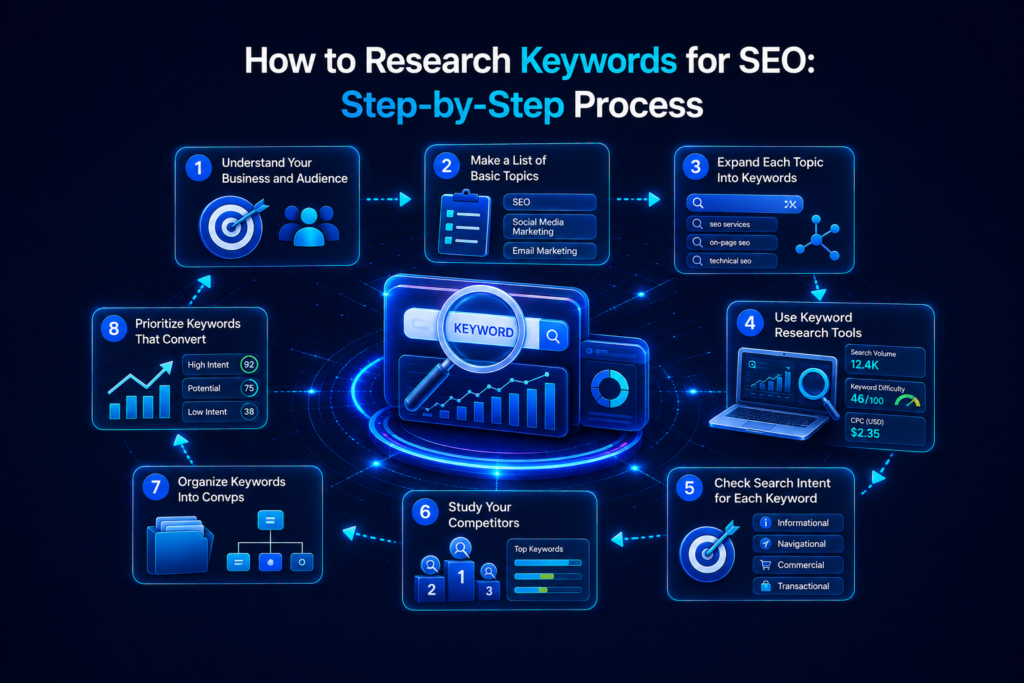
Now let’s get into the main part of this guide. Here is exactly how to research keywords for SEO, explained in simple steps.
Step 1: Understand Your Business and Audience
Before searching for keywords, think about your business. What do you sell? Who are your customers? What problems do you solve for them?
Step 2: Make a List of Basic Topics
Write down simple topics related to your business. For example, if you run a digital marketing agency, topics could be “SEO,” “social media marketing,” or “email marketing.”
Step 3: Expand Each Topic Into Keywords
Under each topic, think of related search phrases people might use. This is a core part of learning how to do SEO keyword research properly.
Step 4: Use Keyword Research Tools
Tools help you find real search data, like how many people search for a keyword and how competitive it is. We’ll cover popular tools in the next section.
Step 5: Check Search Intent for Each Keyword
Make sure the keyword matches what you actually want to offer on that page.
Step 6: Study Your Competitors
Look at what keywords your competitors are ranking for. This often reveals valuable keyword ideas you might have missed.
Step 7: Organize Keywords Into Groups
Group similar keywords together based on topic. This helps you plan content clusters instead of random, unconnected pages.
Step 8: Prioritize Keywords That Convert
Not all keywords bring buyers. Focus on the ones that match strong buying or action-based intent.
How to Do SEO Keyword Research Using Tools
Understanding how to do SEO keyword research becomes much easier once you know which tools to use. Some popular ones include:
- Google Keyword Planner – Free and great for finding search volume and keyword ideas.
- Google Search Console – Shows keywords your website is already getting traffic from.
- Ubersuggest – Beginner-friendly and shows keyword difficulty and volume.
- SEMrush and Ahrefs – Advanced tools for deep keyword and competitor research.
- AnswerThePublic – Shows real questions people ask around a topic.
- Google Autocomplete and “People Also Ask” – Free and simple ways to find real search phrases directly from Google.
Using even one or two of these tools consistently can completely transform your keyword strategy.
Free vs Paid Keyword Research Tools
If you are just starting, free tools like Google Keyword Planner, Google Trends, and Search Console are more than enough to begin. As your business grows and competition increases, paid tools like SEMrush or Ahrefs offer deeper insights, such as competitor keyword gaps and advanced keyword difficulty scores.
How to Find Keywords That Actually Convert
The real goal of any keyword research guide isn’t just to find popular words, but to find keywords that bring real customers. Here’s how to identify them:
- Focus on intent, not just volume. A keyword with fewer searches but strong buying intent is often more valuable than a highly searched but vague keyword.
- Look for problem-solving phrases. Keywords like “how to fix,” “best way to,” or “affordable service for” usually show real interest.
- Check long-tail keywords. These usually convert better because they are specific and match exactly what the searcher wants.
- Study keywords with commercial intent. Words like “buy,” “price,” “near me,” or “service” often lead to actual business inquiries or sales.
Current Trends and Techniques in Keyword Research
SEO keeps changing, and so does keyword research. Here are the latest trends every business should know.
1. AI-Powered Keyword Research
AI tools now help predict keyword trends, group related keywords automatically, and even suggest content ideas based on search patterns.
2. Voice Search Keywords
More people search using voice assistants, so keywords are becoming more conversational, like full questions instead of short phrases.
3. Search Intent Over Search Volume
Search engines are getting smarter at understanding intent, so businesses now focus more on matching intent correctly rather than just chasing high-volume words.
4. Zero-Click Searches and AI Overviews
With Google showing direct answers and AI-generated overviews at the top of search results, keyword research now includes writing clear, direct answers that these AI summaries can easily use.
5. Topic Clusters Instead of Single Keywords
Instead of targeting one keyword per page, modern strategies group related keywords into topic clusters, creating stronger, more complete content around a subject.
6. People Also Ask and Featured Snippets
Optimizing for common questions helps content appear in special Google sections, increasing visibility even without the top overall ranking.
7. Local and “Near Me” Keyword Growth
More users search with location-based phrases, making local keyword research increasingly important, especially for small and local businesses.
Keeping up with these trends ensures your keyword research guide approach stays relevant and effective, not outdated.
Common Mistakes to Avoid During Keyword Research
Even with good tools, many businesses make mistakes while learning how to research keywords for SEO. Avoid these common errors:
- Choosing only high-volume keywords without checking competition or intent.
- Ignoring long-tail keywords that often bring better, more targeted traffic.
- Not updating keyword research regularly, since search trends change over time.
- Stuffing keywords unnaturally into content, which hurts readability and rankings.
- Ignoring competitor keyword strategies, missing valuable opportunities.
Simple Tips for Better Keyword Research
- Always think from the customer’s point of view, not just your business perspective.
- Mix short-tail and long-tail keywords for a balanced strategy.
- Regularly check which keywords are already bringing traffic and improve those pages further.
- Keep a simple spreadsheet to organize and track your keyword list.
- Revisit your keyword strategy every few months, since search behavior keeps changing.
Why Professional Help Makes Keyword Research Easier
Learning how to do SEO keyword research on your own is possible, but doing it correctly and consistently takes time, tools, and experience. A digital marketing expert can help by:
- Finding high-converting keywords specific to your industry
- Studying competitor keyword strategies for hidden opportunities
- Building organized topic clusters instead of random keyword lists
- Keeping your keyword strategy updated with the latest search trends
- Turning keyword research into actual content that ranks and converts
This is exactly the kind of support PerformXEngine’s digital marketing team provides for businesses that want their keyword strategy to bring real, measurable growth.
Final Thoughts
Keyword research is not just a technical SEO task, it’s about truly understanding what your customers are searching for and how you can meet their needs. By following this keyword research guide, understanding how to research keywords for SEO, and learning how to do SEO keyword research using the right tools and trends, your business can attract the right visitors and turn them into real customers.
If you want expert help finding keywords that truly convert and building a smart, up-to-date SEO strategy around them, PerformXEngine’s digital marketing team is ready to help your business grow with the right words, in the right places, at the right time.
Frequently Asked Questions About Keyword Research
What is keyword research in simple words?
Keyword research is the process of finding out what words and phrases people search for online, so businesses can use them to attract the right visitors.
How do I research keywords for SEO as a beginner?
Start by listing your main business topics, use free tools like Google Keyword Planner, check search intent, and organize keywords by topic.
How to do SEO keyword research without paid tools?
You can use free tools like Google Search Console, Google Trends, Google Autocomplete, and “People Also Ask” sections to find useful keywords at no cost.
What are long-tail keywords, and why are they important?
Long-tail keywords are longer, specific search phrases that usually have less competition and higher chances of converting into real customers.
How often should keyword research be updated?
It’s best to review and update your keyword research every three to six months, since search trends and customer behavior change over time.
Can small businesses do their own keyword research?
Yes, small businesses can start with free tools and simple strategies, though professional help can save time and uncover better opportunities.