
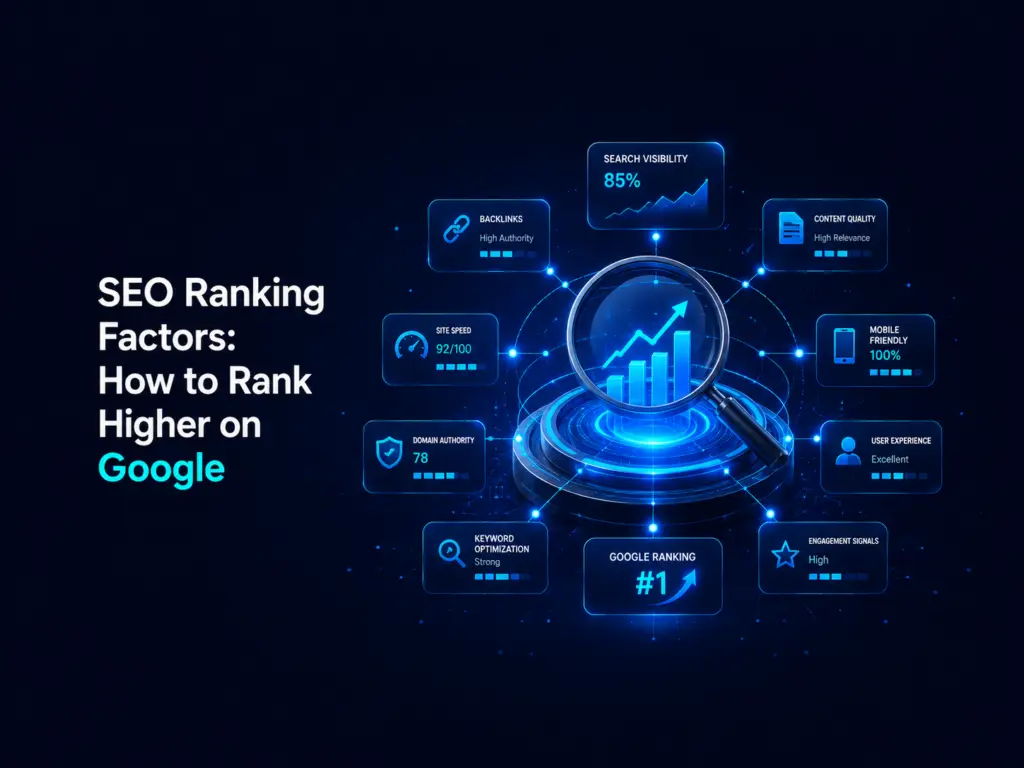
If you’ve ever wondered why one business shows up on page one of Google while a similar business in the same city or industry is nowhere to be found, the answer almost always comes down to SEO ranking factors. These are the signals search engines use to decide which pages deserve to rank higher than others, and understanding them is one of the most valuable things a business owner can do before investing further in digital marketing.
In this guide, we’re breaking down the seo ranking factors that genuinely matter right now, including how search behavior is shifting with AI-driven search, and we’re covering 50+ specific factors you can use as a practical checklist for your own website.
What Are SEO Ranking Factors?
SEO ranking factors are the specific elements and signals that search engines like Google analyze to determine how well a webpage should rank for a given search query. These include everything from the words on your page and the speed of your website, to the number of trustworthy sites linking back to you.
In short, seo ranking factors are the building blocks of search visibility. Get enough of them right, consistently, and your website earns the algorithm’s trust. Ignore them, and even a well-designed website can stay invisible, no matter how good your product or service actually is.
Why Search Engine Ranking Factors Matter for Your Business
For a business owner, understanding search engine ranking factors isn’t just a technical exercise, it directly affects how many potential customers find you online. A website that satisfies more of these factors tends to:
- Rank higher for the keywords your customers are actually searching
- Earn more organic (free) traffic without relying entirely on paid ads
- Build long-term credibility and trust with both search engines and real visitors
- Show up more consistently in AI-generated answers, not just traditional search results
Since Google reportedly considers hundreds of individual signals when ranking a page, no business needs to master every single one. But focusing on the most important SEO factors, the ones with the biggest, most consistent impact, gives you the best return on your time and budget.
Google SEO Ranking Factors 2026: What’s Changed
Search has evolved significantly, and the google seo ranking factors 2026 landscape looks noticeably different from just a couple of years ago. A few key shifts business owners should be aware of:
- AI Overviews and answer engines now sit above traditional search results for many queries, meaning visibility isn’t only about ranking a blue link anymore.
- E-E-A-T (Experience, Expertise, Authoritativeness, Trustworthiness) has become significantly more important, as Google works to filter out low-quality, AI-generated content.
- User experience signals, like Core Web Vitals and mobile usability, now carry more weight than ever, since Google increasingly prioritizes sites that provide a genuinely smooth experience.
- Structured data and clear content formatting matter more, since both traditional search and AI tools rely on well-organized content to extract accurate answers.
Keeping these shifts in mind, let’s get into the full list of ranking factors in seo that matter most going into 2026 and beyond.
The Most Important SEO Factors: 50+ Ranking Factors Business Owners Should Know
Below is a comprehensive, numbered list covering the most important seo factors across every major category, organized so you can quickly scan the ranking factors in seo that apply most to your website. This is a pillar-level overview, so each factor is explained briefly; we’ll cover several of these in much greater depth in future blogs.
Content & On-Page Ranking Factors
- Keyword relevance: How well your content matches the actual intent behind a search query.
- Content quality and depth: Comprehensive, genuinely useful content tends to outperform thin, surface-level pages.
- Search intent match: Whether your page format (guide, product page, comparison, etc.) matches what searchers expect to find.
- Title tag optimization: Clear, keyword-relevant page titles that accurately describe the content.
- Meta description quality: While not a direct ranking factor, a compelling meta description improves click-through rate, which indirectly supports rankings.
- Header tag structure (H1, H2, H3): Logical, well-organized headings help both users and search engines understand your content.
- Content freshness: Regularly updated content signals ongoing relevance and accuracy.
- Internal linking: Connecting related pages helps search engines understand site structure and distribute authority.
- Image optimization: Compressed images with descriptive alt text improve both load speed and accessibility.
- Content originality: Unique insights, data, or perspectives are increasingly valued over duplicated or generic content.
- Readability: Clear, well-formatted writing that’s easy to scan and understand improves user engagement.
- Topical authority: Covering a subject comprehensively across multiple related pages (like a content cluster) builds trust in that topic area.
Technical SEO Ranking Factors
- Site speed: Faster-loading pages are favored by both search engines and users.
- Mobile-friendliness: With mobile-first indexing, your site’s mobile experience is often the primary version Google evaluates.
- HTTPS security: A secure, encrypted connection is a baseline trust signal.
- Crawlability: Ensuring search engines can actually access and crawl your important pages.
- XML sitemap: Helps search engines discover and index your pages efficiently.
- Robots.txt configuration: Properly guiding search engines on what to crawl and what to avoid.
- Clean URL structure: Short, descriptive URLs are easier for both users and search engines to understand.
- Structured data (schema markup): Helps search engines and AI tools understand page context and enables rich results.
- Canonical tags: Preventing duplicate content issues by specifying the preferred version of a page.
- Broken link management: Fixing 404 errors and broken internal links keeps your site healthy.
- Site architecture: A logical, well-organized structure makes it easier for both users and crawlers to navigate.
- Duplicate content avoidance: Unique content across pages prevents confusion and dilution of ranking signals.
Off-Page & Authority Ranking Factors
- Backlink quality: Links from reputable, relevant websites remain one of the strongest trust signals.
- Backlink quantity: A healthy volume of natural backlinks over time supports authority, though quality still outweighs sheer numbers.
- Domain authority: The overall trust and strength of your website as a whole.
- Brand mentions: Even unlinked mentions of your business across the web can contribute to perceived authority.
- Social signals: While not a direct ranking factor, strong social engagement often correlates with increased visibility and traffic.
- Guest posting and PR: Earning coverage or contributions on reputable sites builds authority and referral traffic.
- Anchor text relevance: Natural, relevant anchor text in backlinks supports topical context.
- Link diversity: Backlinks from a variety of domains and sources appear more natural than links concentrated in one place.
User Experience & Core Web Vitals
- Largest Contentful Paint (LCP): Measures how quickly the main content of a page loads.
- First Input Delay / Interaction to Next Paint (INP): Measures how responsive your site feels to user interaction.
- Cumulative Layout Shift (CLS): Measures visual stability, avoiding elements that jump around as a page loads.
- Bounce rate: High bounce rates can signal that a page isn’t meeting searcher expectations.
- Dwell time: How long visitors stay engaged with your content after clicking through.
- Mobile usability: Easy navigation, readable text, and properly sized tap targets on mobile devices.
- Intuitive navigation: A clear menu and site structure that helps users find what they need quickly.
- Accessibility: Sites designed to be usable for people with disabilities tend to perform better overall.
Local SEO Ranking Factors
- Google Business Profile optimization: A complete, accurate, and regularly updated profile supports local visibility.
- NAP consistency: Matching Name, Address, and Phone number across all online listings.
- Local citations: Mentions of your business on relevant local directories and platforms.
- Online reviews: The quantity, quality, and recency of customer reviews influence local rankings.
- Proximity to searcher: How close your business is to the person performing the search.
- Localized content: Pages that reference specific cities, neighborhoods, or regions you serve.
AI Search & Answer Engine Ranking Factors
- Structured, question-based content: Clear questions followed by direct answers, formatted for easy extraction by AI tools.
- E-E-A-T signals: Demonstrated experience, expertise, authoritativeness, and trustworthiness across your content.
- Author credibility: Clear author bios and credentials help establish trust with both readers and algorithms.
- FAQ and schema-marked Q&A sections: Directly formatted question-and-answer content is more likely to be pulled into AI Overviews and voice search results.
- Citation-worthy data and original research: Unique statistics or insights are more likely to be referenced by AI answer engines.
- Content clarity and conciseness: Direct, unambiguous answers are easier for AI systems to summarize accurately.
- Consistent entity information: Making sure your business name, services, and details are described consistently across the web helps AI tools understand who you are.
- Topical depth across a content cluster: Comprehensive coverage of a subject through interlinked pages strengthens both traditional and AI-driven visibility.
How These Ranking Factors Work Together
It’s worth noting that seo ranking factors rarely work in isolation. A technically perfect website with weak content won’t rank well, and brilliant content on a slow, poorly structured site will struggle just as much. Search engines evaluate your website holistically, weighing content quality, technical health, authority, user experience, and increasingly, AI-readiness, all together. Treating the various ranking factors in seo as one connected system, rather than a checklist to tick off in isolation, is what leads to lasting results.
This is exactly why businesses that treat SEO as an ongoing, well-rounded strategy tend to outperform those chasing a single tactic, like just building backlinks or just stuffing keywords onto a page.
Common Myths About SEO Ranking Factors
Before wrapping up, let’s clear up a few misconceptions that often trip up business owners:
- “There’s one secret ranking factor that guarantees success.” In reality, ranking well depends on a broad combination of factors working together consistently.
- “More keywords always help.” Keyword stuffing is outdated and can actively hurt rankings; natural, intent-matched content performs better.
- “Once you rank, you’re done.” Search engine ranking factors evolve constantly, and rankings require ongoing maintenance and optimization.
- “AI Overviews mean traditional SEO doesn’t matter anymore.” Strong SEO fundamentals are still the foundation that supports visibility in AI-driven search as well.
Final Thoughts: Making SEO Ranking Factors Work for Your Business
Understanding seo ranking factors gives you a real advantage as a business owner, because it shifts SEO from a vague, mysterious process into a practical checklist you can actually act on. From content quality and technical health to backlinks, user experience, and the newer AI-focused signals shaping google seo ranking factors 2026, each piece plays a role in how visible your business becomes.
This guide covered the most important seo factors and 50+ specific ranking factors in seo across content, technical, authority, UX, local, and AI search categories, but this is just the foundation. In upcoming cluster blogs, we’ll go deeper into specific areas like technical SEO audits, local SEO strategy, and optimizing content for AI Overviews and answer engines.
If you’re a business owner who wants to strengthen your search visibility but doesn’t have the time or in-house expertise to manage all of these ranking factors consistently, that’s exactly where a dedicated digital marketing partner like Perform X Engine can help, turning this checklist into a real, measurable growth strategy for your business.
Frequently Asked Questions About SEO Ranking Factors
What are SEO ranking factors, in one sentence?
SEO ranking factors are the specific signals, such as content quality, site speed, and backlinks, that search engines use to decide how a webpage should rank for a given search query.
How many search engine ranking factors does Google actually use?
Google has never published an exact number, but it’s widely believed that Google considers hundreds of individual search engine ranking factors, ranging from major signals like content relevance to smaller technical details.
What are the most important SEO factors to focus on first?
For most businesses, the most important seo factors to prioritize early are content quality and search intent match, site speed and mobile-friendliness, and building a small number of high-quality backlinks, since these tend to have the broadest impact on visibility.
Do google seo ranking factors 2026 differ significantly from previous years?
Yes. While core fundamentals like content quality and backlinks remain important, google seo ranking factors 2026 place noticeably more weight on E-E-A-T, Core Web Vitals, and structured content that performs well in AI Overviews and answer engines.
Is it necessary to optimize for every single ranking factor in seo?
No. Trying to perfect every ranking factor in seo at once isn’t realistic or necessary. Focusing consistently on the highest-impact factors, content, technical health, authority, and user experience, delivers the strongest results over time.