
If you are planning to spend money on online advertising, you have probably asked yourself this question: should I use Google Ads, Meta Ads, or both? This is one of the most common questions business owners bring to us at PerformX Engine, and it makes total sense. Both platforms can bring you customers, but they work in very different ways.
In this guide, we will explain everything about Google Ads vs Meta Ads in simple, easy words. We will look at how each platform works, where each one shines, what they cost, and how to decide which one fits your business best. We will also explain why so many smart businesses end up using Google and Meta ads together instead of picking just one.
By the end of this blog, you will know exactly which direction is right for your business goals and your budget.
What Are Google Ads and Meta Ads?
Let’s start with the basics before comparing them.
Google Ads is Google’s advertising platform. It shows your ads when people search for something on Google, watch videos on YouTube, browse websites in the Google Display Network, or check their Gmail inbox. Google Ads is built around one powerful idea: showing your ad to someone at the exact moment they are looking for something.
Meta Ads is the advertising platform used for Facebook and Instagram, along with Messenger and other apps owned by Meta. Instead of waiting for someone to search, Meta Ads places your ad directly into a person’s feed while they are scrolling and browsing, based on their interests, age, location, and online behavior.
This one difference, intent versus interest, is the heart of the entire Google Ads vs Meta Ads comparison, and it shapes almost everything else we will talk about in this blog.
The Core Difference Between Google Ads and Meta Ads
Here is the simplest way to understand it:
- Google Ads finds people who are already looking for something.
- Meta Ads shows your business to people before they even know they need it.
Think of Google Ads like a helpful shop assistant who only talks to customers who already walked in looking for a specific product. Meta Ads is more like a friendly billboard that catches someone’s eye while they are walking around, not actively shopping, but still open to noticing something interesting.
Neither one is “better” in every situation. They simply solve different problems, which is exactly why so many businesses use google and meta ads at the same time as part of one bigger strategy.
How Google Ads Works
Google Ads works mainly through keywords and search intent. When someone types a search like “digital marketing agency near me,” Google instantly runs an auction between advertisers bidding on that keyword, and the winning ads appear on the results page.
Google Ads includes several campaign types, such as:
- Search campaigns: Text ads that show up directly in Google search results.
- Display campaigns: Visual banner ads shown across millions of partner websites.
- YouTube Ads: Video ads shown before, during, or alongside YouTube videos.
- Shopping campaigns: Product listing ads for ecommerce businesses.
- Performance Max campaigns: A single automated campaign type that runs across all of Google’s ad spaces at once.
Because Google Ads is triggered by what someone is actively searching for, it tends to work especially well for businesses that offer something people already know they need, like plumbers, lawyers, software tools, or online stores.
How Meta Ads Works
Meta Ads works differently. Instead of keywords, it relies on audience targeting. Advertisers choose details like age, location, interests, past behavior, and even similarities to their existing customers (called lookalike audiences) to decide who sees their ad.
Meta Ads runs across:
- Facebook feed and stories
- Instagram feed, stories, and reels
- Messenger
- The Meta Audience Network
Meta Ads relies heavily on strong visuals, video, and creative storytelling, since people are not actively searching for anything when they see your ad. Your creative has to stop the scroll and grab attention on its own.
This is one of the biggest practical differences in the entire Google Ads vs Meta Ads discussion: Google rewards relevant keywords and landing pages, while Meta rewards eye-catching creative and smart audience targeting.
Google Ads vs Meta Ads: Cost Comparison
Cost is usually one of the first questions business owners ask, so let’s break it down honestly.
Google Ads often has a higher cost per click, especially for competitive keywords like insurance, legal services, or software. However, because the person searching already has intent, it can often take fewer clicks to turn a visitor into a customer.
Meta Ads usually has a lower cost per click on average. But since people are not actively searching, it can sometimes take more clicks, more impressions, and more retargeting before someone actually converts into a paying customer.
Here is the important lesson: cost per click alone does not tell you which platform is truly cheaper for your business. What really matters is your final cost per conversion, meaning how much you spend to get one actual customer, lead, or sale. A platform with a “cheap” click that never converts is not actually saving you money.
Google Ads vs Meta Ads for Lead Generation
If lead generation is your main goal, both platforms can work, but they play different roles.
Google Ads tends to bring in leads who are already searching for a solution, which usually means they are closer to making a decision. This often leads to higher quality leads, especially for services people search for directly, like “emergency plumber” or “business loan for startups.”
Meta Ads can generate a large volume of leads through lead forms and interest based targeting, but these leads are often earlier in their decision-making process. They may need more nurturing, follow-up emails, or retargeting ads before they are ready to buy.
For many businesses, using google and meta ads together for lead generation creates the best of both worlds: Meta builds early awareness and interest, and Google Ads captures the more serious buyers who are ready to act.
Google Ads vs Meta Ads for Brand Awareness
If your main goal is to get your business name in front of more people, Meta Ads usually has the advantage. Its visual formats, like image ads, video ads, and carousel ads, are built for storytelling and repeated exposure, which helps people remember your brand over time.
Google Ads can also support brand awareness through YouTube Ads and Display campaigns, but its core strength remains capturing existing demand rather than building brand recognition from scratch.
Google Ads vs Meta Ads: Which Is Better for Ecommerce?
Ecommerce businesses often see the best results by using both platforms together, but each one plays a different role.
Google Ads, especially Shopping campaigns and Performance Max, is excellent at capturing people who are already searching for a specific product. Someone searching “buy running shoes online” is very close to making a purchase decision.
Meta Ads is excellent at product discovery. Someone scrolling through Instagram may not have been thinking about running shoes at all until your ad showed up with an attractive image, a good offer, and an easy way to shop.
This is a perfect example of how Google Ads vs Meta Ads is not always an either-or decision. Many successful online stores use Meta Ads to introduce new products and Google Ads to capture the people who are ready to buy.
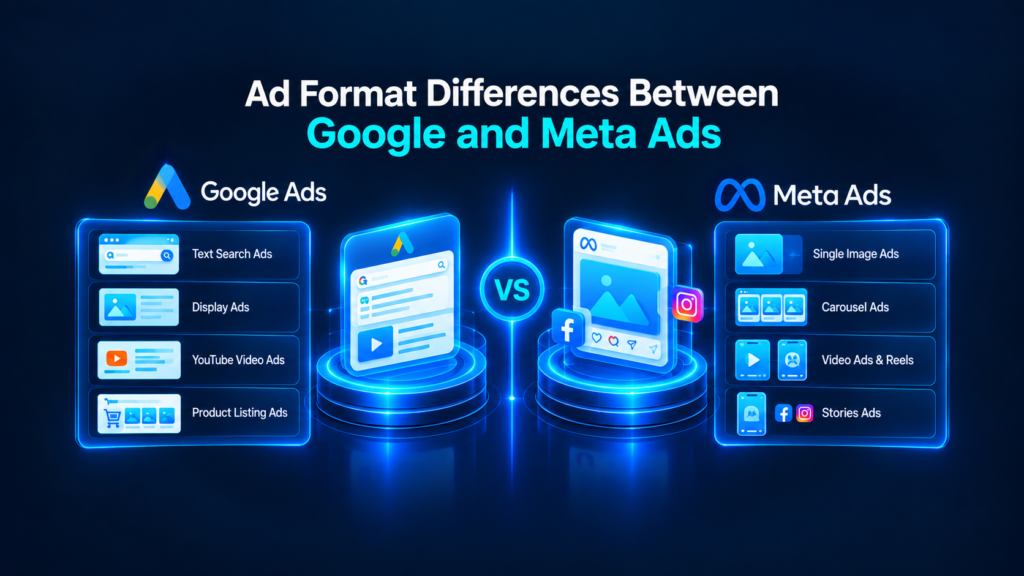
Ad Format Differences Between Google and Meta Ads
Understanding ad formats helps explain why each platform behaves so differently.
Google Ads formats include:
- Text based search ads
- Responsive display ads with images and text
- Video ads on YouTube
- Product listing ads for online stores
Meta Ads formats include:
- Single image ads
- Carousel ads with multiple images or products
- Short form video ads and reels
- Stories ads across Facebook and Instagram
Google Ads formats are built around clear, direct messaging that matches search intent. Meta Ads formats are built around visual appeal and storytelling that catches attention during casual browsing.
How to Decide Between Google Ads and Meta Ads for Your Business
Here is a simple way to think through the decision.
Choose Google Ads if:
- People actively search for what you offer
- You want leads or sales that are ready to convert quickly
- Your business serves a specific local area
- You want measurable, intent driven results
Choose Meta Ads if:
- Your product or service is new and people do not know they need it yet
- You want to build brand awareness and audience trust over time
- You have strong visual content, like product photos or videos
- You want to run lower cost, high volume awareness campaigns
Choose Both Google and Meta Ads if:
- You want a complete strategy that covers the entire customer journey
- You want Meta Ads to build awareness while Google Ads captures the resulting demand
- You have a bigger budget and want to reduce your dependence on just one platform
- You want stronger, more reliable long term results
In our experience at PerformXEngine, most growing businesses eventually benefit from using google and meta ads together rather than picking only one forever. Each platform strengthens the other when they are set up and managed correctly.
Common Mistakes Businesses Make When Comparing Google Ads vs Meta Ads
- Judging performance only by cost per click. A cheap click that never converts is not a good result.
- Expecting Meta Ads to behave like Google Ads. Meta Ads usually needs more time and creative testing before it delivers strong conversions.
- Ignoring landing pages. A weak or slow landing page can ruin the results of either platform, no matter how good your ads are.
- Giving up too early. Both platforms need a proper learning period before their automated systems can perform at their best.
- Never testing both platforms. Some businesses assume they know which platform will work better without actually testing it with real data.
Final Thoughts on Google Ads vs Meta Ads
There is no single winner in the Google Ads vs Meta Ads debate, because both platforms are built to solve different problems. Google Ads is powerful at capturing people who already know what they want. Meta Ads is powerful at introducing your business to people before they even start looking.
The smartest approach is not always choosing one over the other. It is understanding your business goals, your audience, and your budget, then building a strategy that uses google and meta ads in the way that fits your business best.
At PerformXEngine, we help businesses build and manage advertising strategies across both platforms, based on real data and real business goals, not guesswork. If you are still unsure which direction is right for you, our team can help you figure it out with a clear, honest plan.
Ready to build a smarter advertising strategy? Reach out to PerformXEngine today and let’s find the right mix of Google Ads and Meta Ads for your business.
Frequently Asked Questions About Google Ads vs Meta Ads
Is Google Ads better than Meta Ads for small businesses?
It depends on the business. Local service businesses that people actively search for, like electricians or dentists, often see faster results from Google Ads. Businesses with strong visuals or new products often see stronger early results from Meta Ads.
Which is cheaper, Google Ads or Meta Ads?
Meta Ads usually has a lower cost per click, but Google Ads often converts more efficiently because of search intent. The real comparison should always focus on cost per conversion, not just cost per click.
Can I use Google Ads and Meta Ads together?
Yes, and many successful businesses do exactly this. Using google and meta ads together allows you to build awareness through Meta while capturing that demand through Google Ads.
Which platform is better for lead generation?
Google Ads often brings in leads with stronger intent, while Meta Ads can generate a larger volume of early stage leads. Combining both usually produces the strongest lead generation results.
How long does it take to see results from Google Ads or Meta Ads?
Both platforms usually need a few weeks of data collection before their algorithms optimize properly. Expecting instant results from either platform can lead to premature, incorrect conclusions.