
If you have spent any time inside a Google Ads account, you have probably noticed a small number next to each of your keywords, somewhere between 1 and 10. That number is your Google Ads Quality Score, and it might just be one of the most important, and most misunderstood, numbers in your entire account.
At Perform X Engine, we review Quality Score for almost every Google Ads account we work with, because this one score quietly influences how much you pay for clicks, where your ads appear, and whether your campaigns succeed or struggle. Many business owners ask us the same question over and over: “What is quality score in Google Ads, and why does it matter so much?”
In this complete guide, we will answer that question fully. We will explain exactly what is quality score in Google Ads, break down how it is calculated, and walk through practical, proven ways to improve your Google Ads Quality Score. We will keep everything simple and easy to understand, so by the end of this blog, you will feel confident managing this important part of your account.
What Is Quality Score in Google Ads?
Let’s start with a clear, simple definition.
Google Ads Quality Score is a rating, shown on a scale from 1 to 10, that measures how relevant and useful your ads, keywords, and landing pages are to the people searching for them. A score of 10 means Google sees your ad experience as excellent. A score of 1 means Google sees serious problems with relevance or quality.
So when someone asks what is quality score in Google Ads in the simplest possible terms, the answer is this: it is Google’s way of measuring how good your ad experience actually is for the person who searches for your keyword.
This single number affects two of the most important things in your entire account: how much you pay per click, and how well your ads perform in the auction against competitors.
Why Google Ads Quality Score Exists
Google wants to keep its search results useful and trustworthy. If Google showed people low quality, irrelevant, or spammy ads every time they searched for something, people would quickly lose trust in Google Ads altogether, and eventually stop clicking on ads at all.
This is exactly why Google Ads Quality Score exists. It rewards advertisers who create relevant, high quality ad experiences, and it makes life harder, and more expensive, for advertisers who do not. In other words, Quality Score is Google’s system for keeping the entire advertising ecosystem fair and useful for everyone involved.
How Is Google Ads Quality Score Calculated?
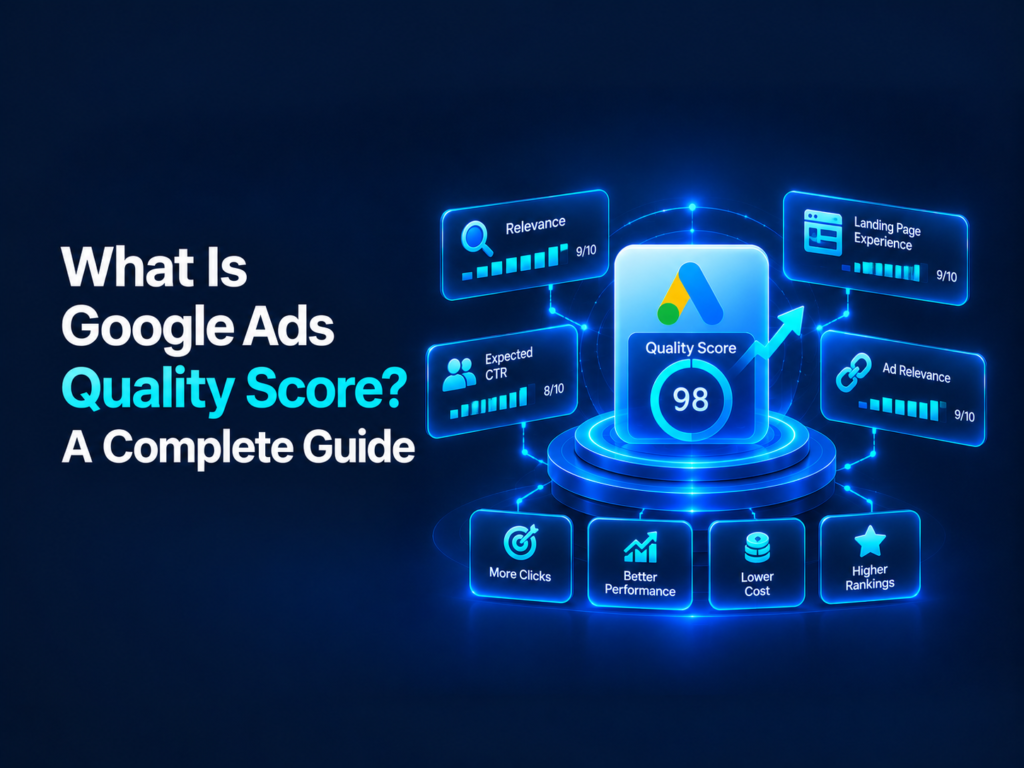
Quality Score is not just one single measurement. It is actually built from three main components, and understanding each one is essential if you want to genuinely improve your score.
1. Expected Click-Through Rate (CTR)
This measures how likely people are to click on your ad when it appears for a specific keyword, compared to other ads competing for that same keyword. Google looks at your ad’s past performance, along with broader industry patterns, to estimate this likelihood.
2. Ad Relevance
This measures how closely your ad’s message matches the actual intent behind the keyword someone searched. If your keyword is “affordable digital marketing services” but your ad talks about something completely different, Google will see this as a relevance problem.
3. Landing Page Experience
This measures how useful, relevant, and easy to use your landing page is once someone actually clicks your ad. Google looks at things like page load speed, mobile friendliness, and whether the page content genuinely matches what the ad and keyword promised.
Google combines these three components to calculate your overall Google Ads Quality Score for each keyword in your account. It is important to understand that Quality Score is calculated separately for every keyword, not just once for your entire account, which means you can have very different scores across different keywords and campaigns.
Why Google Ads Quality Score Matters So Much
Understanding what is quality score in Google Ads is not just an academic exercise. It has real, measurable effects on your campaign performance and your budget. Here is why it matters so much.
It Directly Affects Your Cost Per Click
Advertisers with a higher Quality Score often pay less per click than advertisers with a lower score, even when bidding on the exact same keyword. This is because Google Ads Quality Score is a core part of the Ad Rank formula, which determines both your ad position and how much you actually pay.
It Affects Your Ad Position
A strong Quality Score can help your ad appear in a higher position on the search results page, even if your maximum bid is lower than a competitor’s. This means smaller businesses with smart, relevant campaigns can genuinely outrank bigger competitors who are simply spending more money without focusing on quality.
It Reflects Real Campaign Health
Beyond the direct cost and position benefits, your Quality Score is also a helpful diagnostic tool. A low score on a specific keyword is often a clear signal that something needs attention, whether that is your ad copy, your landing page, or your keyword targeting itself.
Understanding the Google Ads Quality Score Scale
Quality Score is measured on a simple 1 to 10 scale, and Google Ads also shows you a status for each of the three components, labeled as “below average,” “average,” or “above average.” Here is a simple way to think about where your score falls.
| Score Range | What It Means |
| 8 to 10 | Excellent. Your ad experience is strong across relevance, CTR, and landing page. |
| 5 to 7 | Average. There is likely room to improve one or more components. |
| 1 to 4 | Poor. Significant issues exist that are likely increasing your costs and hurting performance. |
Checking these individual component statuses, rather than just the overall number, is one of the most useful things you can do when trying to diagnose and improve your Google Ads Quality Score.
How to Improve Your Google Ads Quality Score
Now let’s get into the practical part. Since Quality Score is built from three components, improving it means addressing each one directly.
1. Improve Your Expected Click-Through Rate
- Write compelling ad headlines that clearly speak to what the searcher is looking for
- Test multiple versions of your ad copy to see which one earns more clicks
- Use strong, clear calls to action that encourage people to click
- Make sure your keywords closely match the actual language people are searching with
2. Improve Ad Relevance
- Keep your ad groups tightly focused around a small set of closely related keywords
- Make sure your ad copy directly reflects the specific keyword it is targeting
- Avoid using overly broad ad groups that try to cover too many unrelated topics at once
- Include your target keyword naturally within your headline and description
3. Improve Landing Page Experience
- Make sure your landing page loads quickly on both desktop and mobile devices
- Ensure the page content clearly matches what your ad and keyword promised
- Keep your landing page mobile friendly and easy to navigate
- Include a clear, obvious call to action so visitors know exactly what to do next
- Remove unnecessary distractions or confusing navigation that might frustrate visitors
4. Organize Your Account Structure Properly
A well organized account, with tightly themed ad groups and closely related keywords, naturally supports stronger relevance and better Quality Score across your entire campaign. Messy, overly broad account structures tend to drag Quality Scores down across the board.
5. Regularly Review and Refresh Your Ads
Ads that have not been updated in a long time can lose relevance over time as search behavior and competition change. Reviewing and refreshing your ad copy regularly helps maintain, and often improve, your Google Ads Quality Score.
Common Myths About Google Ads Quality Score
There is a lot of confusion around this topic, so let’s clear up a few common myths.
Myth 1: A Low Quality Score Means Your Account Is Broken
A low score on one keyword does not mean your entire account is failing. It usually just means that specific keyword needs attention in one or more of its three components.
Myth 2: You Can Buy a Higher Quality Score
There is no way to simply pay Google more money to increase your Quality Score. It must be earned through genuine relevance, strong click-through rates, and a good landing page experience.
Myth 3: Quality Score Is the Same as Ad Rank
While closely related, they are not the same thing. Quality Score is one important input into the Ad Rank formula, but Ad Rank also includes your bid amount and other auction-time factors.
Myth 4: A Perfect Score of 10 Is Always Necessary
While a higher score is generally better, many successful campaigns perform very well with scores in the 7 to 9 range. Chasing a perfect 10 on every single keyword is often not the best use of your time compared to focusing on keywords that matter most to your business goals.
How PerformXEngine Approaches Google Ads Quality Score
At PerformXEngine, we treat Google Ads Quality Score as an ongoing part of campaign management, not a one-time fix. Our approach includes:
- Auditing Quality Score across every keyword in an account, not just looking at overall averages
- Identifying which specific component, CTR, relevance, or landing page, is holding each keyword back
- Rewriting and testing ad copy to improve both relevance and click-through rate
- Optimizing landing pages for speed, mobile experience, and message match
- Reorganizing account structure when needed to support stronger long-term relevance
This consistent, detail focused approach is exactly how we help our clients lower their costs while improving their ad performance over time.
Final Thoughts
Understanding what is quality score in Google Ads gives you real insight into how your campaigns are actually performing, beyond just clicks and impressions. A strong Google Ads Quality Score can lower your costs, improve your ad position, and reflect a genuinely better experience for the people searching for your business.
At Perform X Engine, we help businesses build and manage Google Ads campaigns that focus on real, sustainable improvements to Quality Score, not just short-term fixes. If you want to lower your ad costs while improving your results, our team is here to help.
Ready to improve your Google Ads Quality Score and get more from your ad budget? Reach out to PerformXEngine today and let’s build a smarter, higher performing campaign together.
Frequently Asked Questions About Google Ads Quality Score
What is quality score in Google Ads exactly?
Quality Score is a rating from 1 to 10 that measures how relevant and useful your ads, keywords, and landing pages are, based on expected click-through rate, ad relevance, and landing page experience.
How often does Google Ads Quality Score update?
Quality Score can update regularly based on your account’s recent performance, since it reflects an ongoing measurement rather than a one-time calculation.
Can I check my Google Ads Quality Score directly?
Yes, you can view your Quality Score by adding the “Quality Score” column to your keywords view inside your Google Ads account, along with the individual status for each of the three components.
Does a higher Google Ads Quality Score always mean lower costs?
In most cases, yes. A higher Quality Score generally helps lower your cost per click and improve your ad position, though other auction factors, like competitor bids, also play a role.
Is Google Ads Quality Score the same for every keyword in my account?
No, Quality Score is calculated individually for each keyword, which means you can have a high score on some keywords and a lower score on others within the same account.