
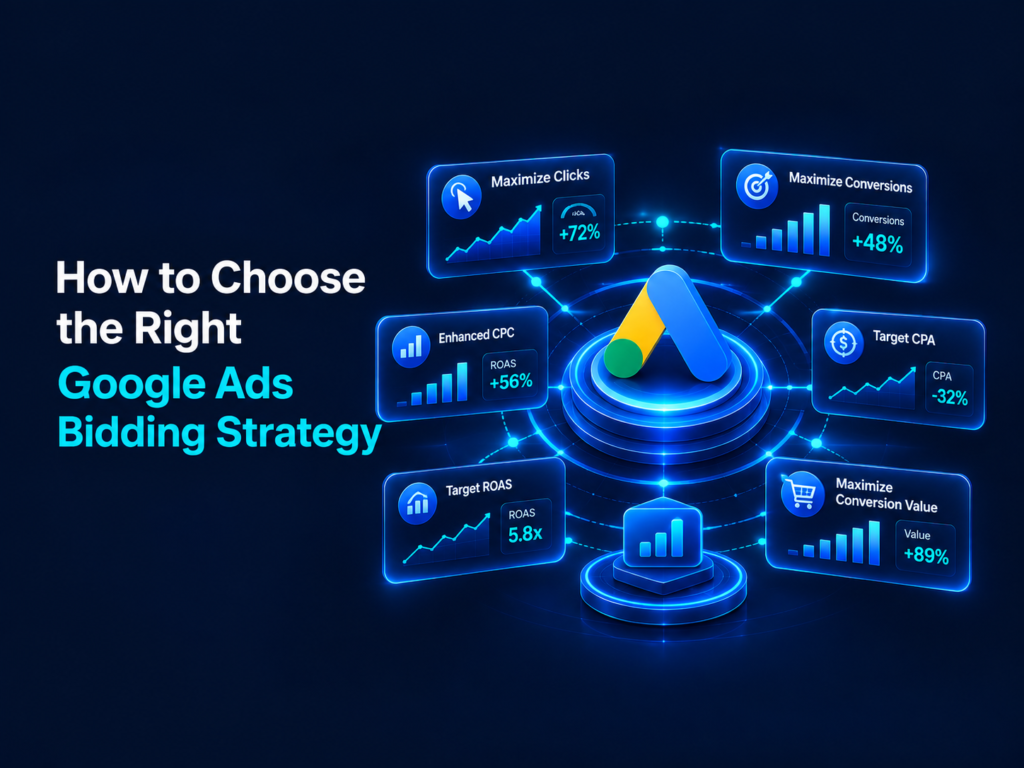
Picking the right Google Ads bidding strategy is one of the biggest decisions you will make inside your Google Ads account. Get it right, and your budget works hard for you, bringing in clicks, leads, and sales at a price you can afford. Get it wrong, and you can burn through your budget fast without seeing real results.
At PerformX Engine, we talk every week with business owners who are confused about this exact topic. They ask us things like, “What are the bidding strategies in Google Ads?” or “Which bid strategy for Google Ads is actually right for my business?” The truth is, there is no single “best” answer for everyone. The right choice depends on your goals, your budget, and how much data your account already has.
In this guide, we will explain everything in simple, clear language. We will walk through every major google ads bidding strategy, explain how each one works, and give you a simple way to decide which bid strategy google ads should use for your specific business. By the end, you will feel confident choosing the right path forward.
Let’s begin.
What Is a Google Ads Bidding Strategy?
A Google Ads bidding strategy is basically a set of rules that tells Google how much to bid, and when, so your ad can win a spot in the ad auction. Every time someone searches on Google, or visits a site in the Google Display Network, an auction happens in less than a second. Your bidding strategy is the plan behind how much money you are willing to put into that auction and what result you want in return.
Some strategies focus on getting the most clicks. Some focus on getting the most sales. Some focus on getting your ad seen by as many people as possible. This is exactly why understanding a bidding strategy for Google Ads is so important, because the strategy you pick shapes almost everything about how your campaign performs.
Why Your Bid Strategy Google Ads Choice Matters So Much
Think of your bidding strategy like the engine of a car. You can have a beautiful car with a great design, comfortable seats, and a shiny paint job, but if the engine is not right for the road you are driving on, the car will not get you where you want to go efficiently.
The same is true here. You could have amazing ad copy and a great landing page, but if your bidding strategy is not aligned with your goals, you might end up:
- Spending your whole budget on clicks that never turn into customers
- Missing out on valuable impressions because your bids are too low
- Paying more per click than you actually need to
- Getting stuck with slow or inconsistent results
This is why choosing the right bid strategy Google Ads offers is not just a “setup step.” It is an ongoing decision that should match your business goals at every stage of your campaign.
Manual Bidding vs Automated Bidding
Before we go through the different types of strategies, let’s cover one basic idea that helps everything else make sense.
Google Ads gives you two big paths to choose from:
Manual Bidding
With manual bidding, you control the actual bid amount for each keyword or ad group yourself. This gives you full control, but it also means you need to check your account often and make adjustments based on performance. It works well for people who want hands-on control or who are just starting to learn how their account behaves.
Automated Bidding (Smart Bidding)
With automated bidding, often called Smart Bidding, Google’s machine learning system sets your bids for you in real time. It looks at hundreds of signals, like device, location, time of day, and past user behavior, to decide the best bid for every single auction. Most modern google ads bidding strategy options fall under this automated category, because Google’s system can react far faster than a human ever could.
For most businesses today, a mix of both, starting manual to learn the account and moving to automated as data builds up, works best.
What Are the Bidding Strategies in Google Ads?
This is the question most people are really asking. Let’s go through each major strategy in simple terms, one at a time.
1. Maximize Clicks
This strategy is built for one simple goal: getting as much traffic to your website as possible within your budget. Google automatically adjusts your bids to get the highest number of clicks it can, without going over your daily budget.
Best for: New websites or campaigns that need traffic and visibility before focusing on conversions.
2. Maximize Conversions
Instead of focusing on clicks, this strategy tells Google to get as many conversions as possible, like form fills, purchases, or sign-ups, using your daily budget. Google uses its own conversion tracking data and machine learning to find the users most likely to convert.
Best for: Accounts that already have some conversion tracking data and are ready to focus on results, not just traffic.
3. Maximize Conversion Value
This is similar to Maximize Conversions, but instead of counting every conversion equally, it focuses on getting you the highest total value from your conversions. This matters a lot for online stores where some orders are worth far more than others.
Best for: Ecommerce businesses and any business where conversion values vary a lot from one sale to another.
4. Target CPA (Cost Per Acquisition)
Target CPA lets you tell Google, “I want to pay around this much money for each customer I acquire.” Google then tries to get you as many conversions as possible while keeping the average cost close to that target number.
Best for: Businesses with a clear idea of how much a new customer or lead is worth to them.
5. Target ROAS (Return on Ad Spend)
Target ROAS is a favorite for ecommerce businesses. You tell Google the return you want for every dollar spent, and the system adjusts bids to hit that target while maximizing conversion value.
Best for: Online stores that track revenue per order and want a predictable return on their ad spend.
6. Target Impression Share
This strategy focuses on visibility rather than clicks or conversions. You choose a percentage of the auctions you want your ad to appear in, and whether you want to show up at the top of the page or anywhere on it.
Best for: Brand awareness campaigns, or protecting your position when people search your own brand name.
7. Enhanced Cost Per Click (ECPC)
ECPC is a hybrid option. You still set your own manual bids, but Google is allowed to raise or lower them slightly based on how likely a click is to turn into a conversion. It is a nice middle ground between full manual control and full automation.
Best for: Advertisers who want to keep manual control but get a small automated boost.
8. Cost Per Thousand Impressions (CPM) and Viewable CPM (vCPM)
These strategies charge you based on impressions rather than clicks. You pay for every 1,000 times your ad is shown (or viewably shown, in the case of vCPM). These are mostly used on the Google Display Network and YouTube.
Best for: Pure brand awareness goals where visibility matters more than direct clicks.
9. Cost Per View (CPV)
CPV bidding is used specifically for YouTube video campaigns. You set the maximum amount you are willing to pay when someone watches your video ad or interacts with it.
Best for: Video advertising campaigns focused on views and engagement rather than website clicks.
10. Portfolio Bid Strategies
A portfolio bid strategy lets you apply one automated strategy, like Target CPA or Target ROAS, across multiple campaigns at once instead of setting it up separately for each one. This is useful for larger accounts managing many campaigns together.
Best for: Bigger advertisers running several campaigns that share the same overall goal.
How to Choose the Right Google Ads Bidding Strategy
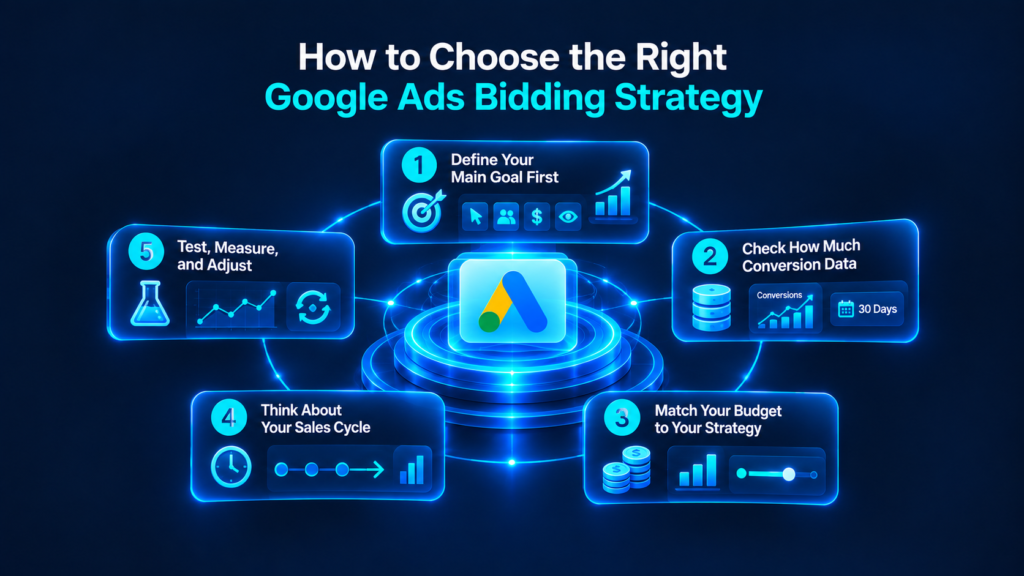
Now that you understand what are the bidding strategies in Google Ads, let’s talk about how to actually pick the right one for your business. Follow these simple steps.
Step 1: Define Your Main Goal First
Before touching any settings, ask yourself: What do I actually want from this campaign?
- Do you want more website visitors? Consider Maximize Clicks.
- Do you want more leads or sales at a set cost? Consider Target CPA.
- Do you want the highest possible revenue from your ad spend? Consider Target ROAS or Maximize Conversion Value.
- Do you want more brand visibility? Consider Target Impression Share or CPM bidding.
Your goal should always come before your strategy, never the other way around.
Step 2: Check How Much Conversion Data You Already Have
Smart Bidding strategies, like Target CPA and Target ROAS, need enough historical conversion data to work well. Google generally recommends having a healthy number of conversions in the past 30 days before switching to these advanced strategies. If your account is brand new, starting with Maximize Clicks or Maximize Conversions first, then moving to Target CPA or Target ROAS later, usually works much better.
Step 3: Match Your Budget to Your Strategy
If your daily budget is small, some strategies, like CPM bidding for pure brand awareness, might not be the most efficient use of your money. Instead, a tighter, more conversion focused bid strategy Google Ads offers, like Target CPA or Maximize Conversions, will usually stretch a smaller budget further.
Step 4: Think About Your Sales Cycle
If your product or service has a long sales cycle, where people take days or weeks to make a decision, a strategy focused only on clicks will not tell the full story. In this case, look at strategies built around actual conversions, like Target CPA, so Google is optimizing toward real business results, not just website visits.
Step 5: Test, Measure, and Adjust
No bidding strategy should be set once and forgotten forever. Give a new strategy enough time, usually two to four weeks, to gather data and let Google’s machine learning settle into a stable pattern. Then review the results and decide if it is time to adjust your target numbers or try a different approach.
A Simple Comparison Table
| Goal | Recommended Google Ads Bidding Strategy |
| Get more traffic quickly | Maximize Clicks |
| Get more leads or sign-ups | Maximize Conversions or Target CPA |
| Get more sales revenue | Maximize Conversion Value or Target ROAS |
| Build brand visibility | Target Impression Share or CPM |
| Grow YouTube views | Cost Per View (CPV) |
| Manage many campaigns together | Portfolio Bid Strategy |
Common Mistakes to Avoid When Choosing a Bid Strategy Google Ads Offers
- Switching strategies too often. Every time you change your bidding strategy, Google’s system needs time to learn again. Constant switching keeps your campaign stuck in a “learning phase” and hurts performance.
- Choosing Target CPA or Target ROAS too early. Without enough conversion history, these smart strategies can struggle to find the right pattern.
- Ignoring your actual business goals. Picking a strategy because it “sounds advanced” instead of because it fits your goal is one of the most common and costly mistakes.
- Setting unrealistic targets. Setting a Target CPA or Target ROAS that is far from what your account can realistically achieve often leads to fewer impressions and slower results.
- Not reviewing performance regularly. Even a well chosen strategy needs occasional check-ins to make sure it still matches your goals.
Why Professional Guidance Makes a Big Difference
Choosing the right google ads bidding strategy involves a mix of data analysis, business understanding, and ongoing testing. This is exactly the kind of work our team handles every day at PerformXEngine. We look at your business goals, your budget, your industry, and your account history before recommending any bidding strategy for Google Ads, because a strategy that works beautifully for one business can perform poorly for another.
Our approach always starts with your actual goals, not a generic template. We track results closely, adjust bids and targets as real data comes in, and make sure your ad spend is always working toward the outcome that matters most to your business.
Final Thoughts
Choosing the right Google Ads bidding strategy is not about picking the fanciest or most “automated” sounding option. It is about matching the strategy to your real business goals, your budget, and the amount of data your account already has. Whether you need more traffic, more leads, more sales, or more brand visibility, there is a bid strategy Google Ads offers that fits your situation.
If you are still unsure which bidding strategy for Google Ads is right for your business, our team at PerformX Engine is here to help. We build data driven Google Ads strategies designed around your specific goals, so every dollar of your budget is working as hard as possible.
Ready to stop guessing and start growing? Reach out to PerformXEngine today and let’s build the right bidding strategy for your business together.
Frequently Asked Questions About Google Ads Bidding Strategy
What is the best bidding strategy for a brand new Google Ads account?
For most new accounts, Maximize Clicks or Maximize Conversions works best at the start, since the account does not yet have enough data for advanced strategies like Target CPA or Target ROAS.
What are the bidding strategies in Google Ads that focus purely on sales?
Target ROAS and Maximize Conversion Value are the two strategies built specifically around getting the highest possible revenue from your ad spend.
Can I switch my bid strategy Google Ads is currently using at any time?
Yes, you can switch strategies whenever you want, but frequent switching can restart the learning phase and temporarily reduce performance, so it is best to switch only when you have a clear reason to.
Is automated bidding better than manual bidding?
Not always. Automated bidding tends to perform better once your account has enough conversion data, but manual bidding can offer more control for newer accounts or very specific campaign goals.
How long should I wait before judging a new bidding strategy?
Give any new bidding strategy for Google Ads at least two to four weeks before making a final judgment, since Google’s system needs time to learn and stabilize.