
If you run ads on Google, you have probably asked yourself one simple question: “Why is my competitor’s ad showing above mine, even though I am bidding more money?”
The answer to that question has one name: Google Ad Rank.
At PerformXEngine, we manage Google Ads campaigns for businesses every single day, and Ad Rank is one of the most misunderstood parts of the entire Google Ads system. People think it is only about money. It is not. Google Ad Rank is a score, and this score decides two big things: where your ad shows up on the search page, and whether your ad shows up at all.
In this guide, we will explain everything about Google Ad Rank in simple words. We will break down what is ad rank, how to improve ad rank, and how Google ads ranking really works behind the scenes. By the end, you will understand this topic better than most marketers, and you will know exactly what steps to take next.
Let’s get started.
What Is Ad Rank in Google Ads?
So, what is ad rank exactly?
Google Ad Rank is a value that Google calculates every single time someone searches for something on Google and there are ads competing for that search. This value decides:
- Whether your ad is shown at all
- In what position your ad appears on the page (1st, 2nd, 3rd, and so on)
- How much you actually pay for each click
Think of it like a competition. Every time a person types something into Google, all the advertisers who are bidding on that keyword enter into a quick, invisible race. This race is called the ad auction, and it happens in less than a second. Google Ad Rank is the score used to decide who wins that race and where each ad lands on the results page.
Here is the simple truth that many businesses do not realize: the advertiser with the biggest budget does not always win. A small business with a smart, relevant, well built ad can beat a big company that is spending five times more money. That is the real power of understanding Google ads ranking.
Why Does Google Ad Rank Even Exist?
Google wants one thing above everything else: happy users. If Google shows people bad, irrelevant, or spammy ads, those people will stop trusting Google search and will use it less. So Google built a system that rewards ads that are actually useful and punishes ads that are not, no matter how much money is behind them.
This is why Google Ad Rank exists. It keeps the playing field fair and keeps the ads useful for the person searching. This also means that if you focus only on raising your bid and ignore the quality of your ad, you are working against the system, not with it.
The Google Ad Rank Formula Explained Simply
Let’s break down the actual formula. Don’t worry, we will explain it like you are learning it for the very first time.
At a basic level, the formula looks like this:
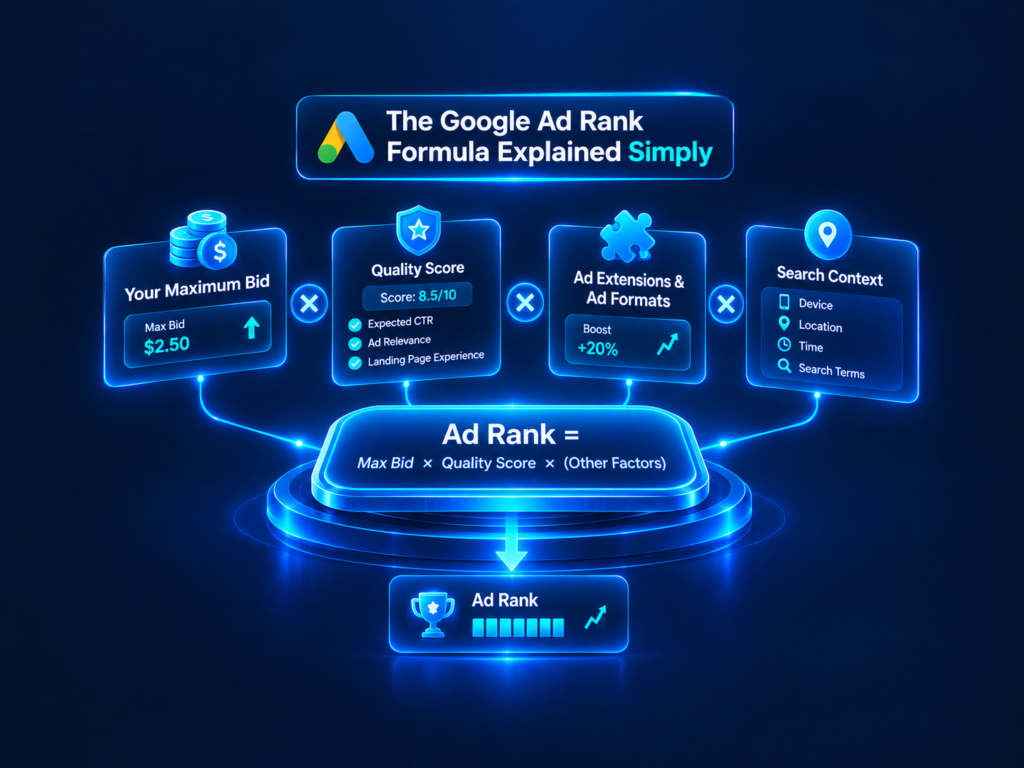
Ad Rank = Your Maximum Bid x Quality Score x (Other Ranking Factors)
Let’s explain each part in plain, simple language.
1. Your Maximum Bid
This is the highest amount of money you are willing to pay for one click on your ad. You set this number yourself inside your Google Ads account. A higher bid can help you, but by itself it is not enough to win a top spot.
2. Quality Score
Quality Score is Google’s way of measuring how good and how relevant your ad actually is. It is rated on a scale from 1 to 10, where 10 is excellent and 1 is poor. Quality Score is built from three main pieces:
- Expected click-through rate (CTR): How likely people are to click your ad when they see it.
- Ad relevance: How closely your ad matches what the person is actually searching for.
- Landing page experience: How useful, fast, and easy to use the page is once someone clicks your ad.
3. The Expected Impact of Ad Extensions and Ad Formats
Google also looks at extra pieces of information you add to your ad, like phone numbers, site links, and extra descriptions. These are called ad extensions or “ad formats,” and using them properly can boost your Google ads ranking.
4. Context of the Search
Google also studies the situation of the search itself. This includes things like the device being used, the location of the searcher, the time of day, the exact words used in the search, and even what other ads and results are showing on that page at that moment.
When you put all of these pieces together, Google calculates a final Ad Rank score for every advertiser in that auction. The advertiser with the highest score gets the best position on the page.
Ad Rank vs Ad Position: What Is the Difference?
Many people use these two terms as if they mean the same thing, but they are actually a little different, and understanding the difference will help you understand Google ads ranking much better.
- Ad Rank is the score, the internal number Google calculates using the formula above.
- Ad Position is the actual spot where your ad shows up on the search results page, like position 1, position 2, or position 3.
In simple words: your Ad Rank score decides your Ad Position. A higher Ad Rank score means a better (higher) Ad Position on the page.
How Does the Google Ads Auction Actually Work?
Let’s walk through this step by step, just like a story, so it is easy to picture in your head.
- A person searches for something on Google, for example, “digital marketing agency near me.”
- Instantly, Google looks at all the advertisers who are bidding on that keyword or related keywords.
- Google calculates the Ad Rank for each of those advertisers using the formula we explained above.
- Google lines up the ads from the highest Ad Rank score to the lowest.
- The ads are displayed on the search page in that exact order.
- The amount each advertiser actually pays is calculated using something called the Ad Rank Thresholds, which basically means you usually pay just enough to beat the advertiser below you, not your full maximum bid.
This entire process happens in a fraction of a second, every single time someone searches on Google. It happens millions and millions of times every day, all across the world.
A Simple Example to Understand Google Ad Rank
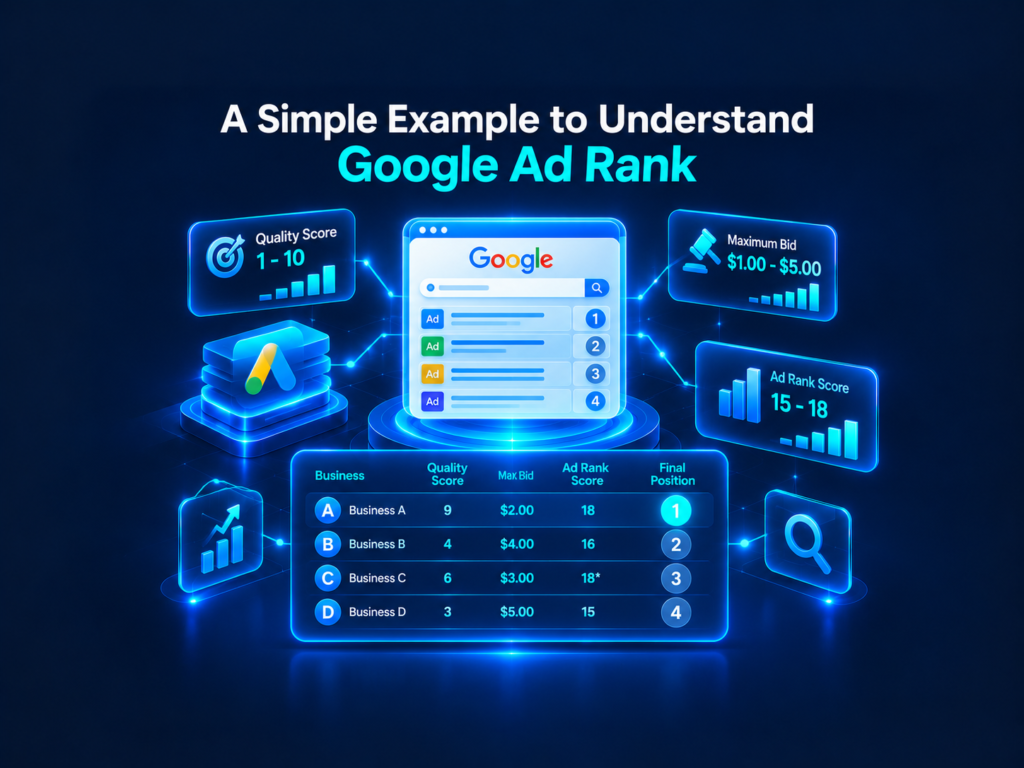
Let’s use an easy example with pretend numbers so the idea becomes crystal clear.
| Business | Quality Score (1-10) | Maximum Bid | Ad Rank Score | Final Position |
| Business A | 9 | $2.00 | 18 | 1 |
| Business B | 4 | $4.00 | 16 | 2 |
| Business C | 6 | $3.00 | 18* | 3 |
| Business D | 3 | $5.00 | 15 | 4 |
*Business C ties with Business A in this example, but loses the tiebreaker because Business A has a longer, more consistent account history.
Look closely at Business A and Business B. Business B is spending twice as much money as Business A, but Business A still wins the top spot because its Quality Score is much higher. This one example shows exactly why Google Ad Rank is not just about spending power. It rewards businesses that build smart, relevant, useful ads.
This is exactly the kind of strategy our team focuses on at PerformXEngine when we manage Google Ads campaigns for our clients. We do not simply chase bigger budgets. We build a stronger Ad Rank score so our clients get better positions while spending their budget wisely.
How to Improve Ad Rank: Step by Step Strategies
Now let’s get to the part everyone really wants to know: how to improve ad rank. Below are proven, practical strategies that actually move the needle.
1. Improve Your Quality Score First
Since Quality Score is such a huge part of the Ad Rank formula, improving it is usually the fastest and cheapest way to improve your Google ads ranking. Focus on these three things:
- Write ad copy that closely matches the exact keywords you are bidding on.
- Make sure your landing page loads fast and works well on mobile phones.
- Keep your ad groups tightly organized around one clear topic instead of mixing many unrelated keywords together.
2. Write Highly Relevant Ad Copy
Google rewards ads that feel like a direct, honest answer to what the person typed into the search bar. If someone searches “affordable digital marketing services,” your headline should speak directly to that phrase, not something vague and generic.
3. Build a Strong Landing Page Experience
Your landing page is not just a place to send clicks. It is part of the Google ads ranking formula itself. A good landing page should:
- Load in under three seconds
- Match the promise made in your ad
- Be easy to read and navigate on a mobile phone
- Have a clear, simple call to action
4. Use All Relevant Ad Extensions
Ad extensions (like call buttons, location info, site links, and extra text) give Google more reasons to trust that your ad is helpful and complete. Using them properly is one of the easiest wins for improving your Ad Rank.
5. Improve Your Expected Click Through Rate
Google is always watching how often people click your ad compared to how often it is shown. If your CTR is strong, Google sees this as proof that your ad is genuinely useful, and it rewards you with a better position, often for a lower cost per click.
6. Organize Your Keywords Tightly
Group your keywords into small, focused ad groups that share a very similar theme. This lets you write extremely relevant ad copy for each group, which naturally improves your Quality Score and, in turn, your Ad Rank.
7. Test Your Ad Copy Regularly
Never “set and forget” your ads. Keep testing new headlines, descriptions, and calls to action. Over time, small improvements to your ad copy add up to a meaningfully stronger Google ads ranking.
8. Remove Irrelevant Traffic With Negative Keywords
Add negative keywords so your ad does not show up for searches that do not match your business. This protects your click through rate and your Quality Score, both of which feed directly into a stronger Ad Rank.
Common Mistakes That Hurt Your Google Ads Ranking
Let’s also cover a few mistakes we see very often, so you can avoid them.
- Only increasing the bid and ignoring Quality Score. This is the most expensive mistake advertisers make.
- Sending all your ads to the same generic landing page. This lowers relevance and hurts your score.
- Using very broad, unfocused keywords in one giant ad group. This makes it almost impossible to write relevant ad copy.
- Ignoring mobile page speed. A slow loading page on mobile devices can quietly destroy your landing page experience score.
- Never testing new ad variations. Ads that stay the same for months often lose performance over time as user behavior shifts.
Why Google Ad Rank Matters for Your Business Growth
Understanding what is ad rank is not just a technical detail for marketing experts. It directly affects your business results in real, measurable ways:
- Lower cost per click: A strong Ad Rank often means you pay less for the same, or even a better, position.
- Better ad positions: Higher positions get more clicks, and more clicks generally mean more customers.
- Stronger return on ad spend: When your Quality Score is high, your money works harder for you.
- More trust from Google: Accounts with consistently strong Quality Scores tend to perform better across all future campaigns too.
This is exactly why, at PerformXEngine, we treat Google ads ranking as a core part of every paid campaign strategy we build, not just an afterthought.
Final Thoughts on Google Ad Rank
Google Ad Rank might sound complicated at first, but once you break it down, it is really just Google’s way of asking one simple question: “Is this ad actually good and useful for the person searching?”
The businesses that win in Google ads ranking are not always the ones with the biggest budgets. They are the ones that understand the formula, build relevant ads, create strong landing pages, and keep improving over time.
If you want expert help improving your Ad Rank and getting better results from every dollar you spend on Google Ads, our team at PerformX Engine is ready to help. We build data driven, performance focused Google Ads campaigns that are designed to win, not just compete.
Ready to improve your Google ads ranking and lower your cost per click? Reach out to PerformXEngine today and let’s build a smarter ad strategy together.
Frequently Asked Questions About Google Ad Rank
What is Ad Rank in one simple sentence?
Ad Rank is the score Google uses to decide the position of your ad on the search results page and whether your ad appears at all.
Does a higher bid always mean a higher ad position?
No. A high bid helps, but a low Quality Score can still push your ad below a competitor who is bidding less money but has a stronger, more relevant ad.
How can I check my Quality Score?
You can view your Quality Score directly inside your Google Ads account by adding the “Quality Score” column to your keywords report.
How to improve ad rank quickly?
The fastest results usually come from improving ad relevance, writing tightly targeted ad copy, and fixing slow or unclear landing pages.
Is Google Ad Rank the same for every industry?
The formula stays the same, but the level of competition and average Quality Scores can vary a lot between industries, which changes how much bid or Quality Score improvement you need to win a top spot.