
Have you ever sent an email to your customers and then wondered, “Did this actually work?” If yes, you are not alone. Many business owners send emails without knowing what success looks like. This is where email marketing goals and email marketing KPIs come in.
In this blog, we will explain everything in simple words. You will learn what goals and KPIs really mean, why they matter, and how to set them the right way for your business. By the end, you will know exactly which kpi for email marketing to track and how to turn your email campaigns into real results.
What Are Email Marketing Goals?
Email marketing goals are simply the things you want to achieve by sending emails to your customers. A goal is like a destination. Without a goal, you are just sending emails without knowing where you are heading.
Some common examples of email marketing goals are:
- Getting more people to visit your website
- Selling more products
- Getting more people to sign up for your service
- Keeping old customers happy and engaged
- Building trust with new customers
When a business sets clear email marketing goals, every email sent has a purpose. This makes it easier to plan better content and measure success later.
What Are Email Marketing KPIs?
Now let’s talk about email marketing KPIs. KPI stands for “Key Performance Indicator.” In simple words, a KPI is a number that tells you how well something is working.
Think of it like a school report card. Your grades tell you how well you are doing in each subject. In the same way, email marketing KPIs tell you how well your emails are performing.
For example, if your goal is to get more website visitors, one useful kpi for email marketing would be the click rate, which tells you how many people clicked the link inside your email.
So, goals tell you “what you want,” and KPIs tell you “how well you are doing to get there.”
Why Email Marketing Goals and KPIs Matter So Much
Many businesses skip this step and just send emails randomly. This usually leads to poor results and wasted effort. Here is why setting proper email marketing goals and tracking the right kpis for email marketing is so important.
1. It Gives Direction
When you know your goal, you know what kind of email to write, what offer to include, and who to send it to.
2. It Helps You Measure Real Success
Without KPIs, you are only guessing if your email worked. With KPIs, you have actual numbers to prove it.
3. It Saves Time and Money
When you track the right KPIs, you quickly learn what is working and what is not, so you can stop wasting money on emails that don’t perform well.
4. It Helps You Improve Over Time
Every campaign teaches you something new. By checking your email marketing KPIs regularly, you can slowly make your emails better and better.
How to Set Email Marketing Goals the Right Way
Setting good email marketing goals is not difficult once you understand the basic steps. Here is a simple process.
Step 1: Know What You Want
Ask yourself, “What do I want this email to do?” Do you want more sales? More website visits? More sign-ups? Be clear about it.
Step 2: Make Your Goal Specific
Instead of saying “I want more sales,” say “I want 50 more sales this month from email.” A specific goal is always easier to track.
Step 3: Set a Time Limit
Every goal should have a deadline, like one week, one month, or one quarter. This keeps you focused.
Step 4: Make It Realistic
Your goal should be possible to achieve based on your current email list size and business type. Don’t expect huge results overnight.
Step 5: Connect It to a KPI
Every goal needs a matching KPI so you can measure it properly. This is where kpis for email marketing become useful.
A simple way to remember this is the SMART method: Specific, Measurable, Achievable, Realistic, and Time-based.
Important KPIs for Email Marketing You Should Track
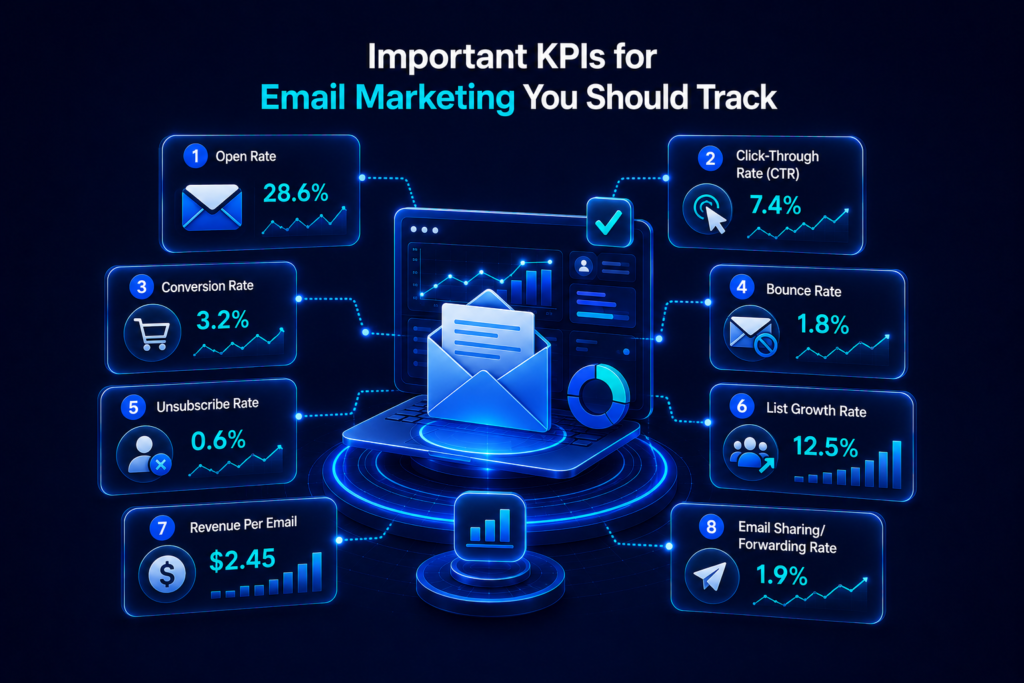
Now let’s go through the most useful email marketing KPIs that every business should know about.
1. Open Rate
This tells you how many people opened your email. A low open rate usually means your subject line needs improvement.
2. Click-Through Rate (CTR)
This is one of the most important kpi for email marketing metrics. It tells you how many people clicked a link inside your email. This shows how interesting and useful your email content is.
3. Conversion Rate
This tells you how many people took the final action you wanted, like buying a product or filling out a form, after clicking your email.
4. Bounce Rate
This shows how many emails did not reach the customer’s inbox. A high bounce rate usually means your email list needs cleaning.
5. Unsubscribe Rate
This tells you how many people chose to stop receiving your emails. If this number is high, it may mean your emails are too frequent or not relevant.
6. List Growth Rate
This shows how fast your email list is growing. A healthy list growth means more people are interested in your business.
7. Revenue Per Email
This is one of the most important kpis for email marketing for businesses that sell products online. It tells you exactly how much money each email campaign is generating.
8. Email Sharing/Forwarding Rate
This tells you how many people liked your email enough to share or forward it to someone else. It shows strong engagement.
How to Choose the Right KPI for Email Marketing
Not every KPI matters equally for every business. Choosing the right kpi for email marketing depends on your specific goal.
- If your goal is brand awareness, focus on open rate and list growth rate.
- If your goal is website traffic, focus on click-through rate.
- If your goal is sales, focus on conversion rate and revenue per email.
- If your goal is keeping your list clean and healthy, focus on bounce rate and unsubscribe rate.
This is why goals and KPIs always work together. Your email marketing goals decide which kpis for email marketing actually matter for your business.
Examples of Email Marketing Goals and Matching KPIs
Here are a few simple examples to make this even easier to understand.
Goal: Increase online sales by 20% in two months Matching KPI: Conversion rate, revenue per email
Goal: Grow the email subscriber list by 500 people this month Matching KPI: List growth rate
Goal: Improve customer engagement with weekly newsletters Matching KPI: Open rate, click-through rate
Goal: Reduce unwanted unsubscribes Matching KPI: Unsubscribe rate
These examples show how email marketing goals and email marketing KPIs always go hand in hand.
Common Mistakes Businesses Make With Email Marketing Goals and KPIs
Even with good intentions, many businesses make mistakes while setting up their email marketing goals and KPIs. Here are some common ones to avoid.
- Setting no goal at all: Sending emails without any clear purpose.
- Tracking too many KPIs at once: This creates confusion instead of clarity.
- Ignoring bad numbers: Not fixing a high bounce rate or unsubscribe rate.
- Comparing with unrelated businesses: Every business is different, so results will vary.
- Not testing subject lines or content: This limits improvement over time.
Simple Tips to Track KPIs for Email Marketing Successfully
- Use an email marketing tool that provides clear reports and analytics.
- Check your email marketing KPIs weekly or monthly, depending on your campaign size.
- Always compare current results with your past campaigns.
- Test small changes, like subject lines or send times, to see what improves your KPIs.
- Clean your email list regularly to keep your bounce rate low.
- Keep your goals updated as your business grows.
Why Professional Help Makes a Big Difference
Setting email marketing goals and choosing the right kpis for email marketing sounds simple, but doing it correctly, and consistently, takes experience. A digital marketing expert can help you:
- Set realistic and result-driven goals
- Choose the right KPIs based on your business type
- Build better email campaigns that get real engagement
- Analyze results properly and suggest improvements
- Save time by avoiding trial-and-error mistakes
This is exactly the kind of support PerformXEngine’s digital marketing team provides for businesses that want their email marketing to actually deliver results, not just fill up inboxes.
Final Thoughts
Every successful email campaign starts with a clear goal and ends with real numbers to measure success. By setting proper email marketing goals and tracking the right email marketing KPIs, your business can send smarter emails, save money, and see real growth over time.
Whether you are just starting your email marketing journey or want to improve your current strategy, understanding which kpis for email marketing matter most for your goals will make a huge difference.
If you want expert help setting up the right goals, choosing the best KPIs, and running email campaigns that actually convert, PerformXEngine’s digital marketing team is ready to help your business grow with smarter, data-driven email marketing.
Frequently Asked Questions About Email Marketing Goals and KPIs
What are email marketing goals?
Email marketing goals are the specific results a business wants to achieve through email campaigns, such as more sales, more website visits, or more subscribers.
What is a KPI in email marketing?
A KPI, or Key Performance Indicator, is a number used to measure how well an email campaign is performing, such as open rate or click-through rate.
What is the most important KPI for email marketing?
There isn’t one single most important KPI. The right kpi for email marketing depends on your goal, such as conversion rate for sales or open rate for brand awareness.
How many KPIs should a business track for email marketing?
It’s best to focus on 3 to 5 key KPIs that directly match your business goals, instead of tracking too many numbers at once.
How often should I check email marketing KPIs?
Most businesses check their KPIs weekly or monthly, depending on how often they send email campaigns.
Can small businesses use email marketing goals and KPIs too?
Yes, email marketing goals and KPIs work for businesses of any size. Even a small local business can set simple goals and track basic KPIs to improve results.