
One of the most common questions business owners ask when starting paid social campaigns is simple: which platform should I actually advertise on? With so many social media platforms available today, each with its own audience, ad formats, and pricing structure, picking the wrong one can quietly drain your budget with little to show for it, sometimes for months before anyone notices the mismatch.
This guide walks through the major social media platforms for business, how they differ, and a practical framework for choosing the best social media platforms for your specific goals, audience, and budget, so you can make this decision with confidence rather than guesswork.
Why Choosing the Right Social Media Platforms Matters
Not all social media platforms serve the same purpose, and treating them as interchangeable is one of the most common mistakes businesses make. A platform that performs brilliantly for a fashion brand might perform poorly for a B2B software company, simply because the audience, content style, and buying behavior are completely different.
Choosing the right social media platforms for business affects nearly everything downstream, including:
- How much you’ll pay per click, lead, or impression
- The type of creative content you’ll need to produce consistently
- How quickly you can expect to see meaningful results
- Whether you’re reaching people at the awareness stage, consideration stage, or ready to buy
Getting this decision right early saves both budget and time, while getting it wrong often leads business owners to conclude that “social media advertising doesn’t work,” when the real issue was simply platform mismatch.
Overview of the Major Social Media Platforms for Business
Before choosing, it helps to understand what each of the major social media platforms actually offers. Here’s a breakdown of the most widely used options for business advertising today.
Facebook & Instagram (Meta Ads)
Meta’s combined advertising platform remains one of the most versatile social media platforms for business, thanks to its massive user base and detailed targeting options. It works well across nearly every industry, including e-commerce, local services, healthcare, real estate, and consumer products. Instagram tends to favor visually strong brands, while Facebook often performs well for lead generation and local businesses through detailed demographic and interest-based targeting.
LinkedIn Ads
LinkedIn is widely considered one of the best social media platforms for B2B businesses, recruiters, and companies targeting professionals. You can target by job title, industry, company size, and seniority, which makes it especially effective for high-ticket B2B offers, even though the cost per click tends to be higher than other platforms.
TikTok Ads
TikTok has grown into a genuinely powerful advertising channel, particularly for reaching younger audiences through short-form, highly engaging video content. Brands with a strong creative angle, entertainment value, or authentic storytelling tend to perform exceptionally well here.
YouTube Ads
As a video-first platform with an enormous, broad audience, YouTube works well for brand awareness, product demonstrations, and storytelling-driven campaigns. It’s particularly effective for businesses that already have strong video content or the resources to create it.
Pinterest Ads
Often overlooked, Pinterest is one of the best social media platforms for business in visually driven niches like fashion, home decor, food, and wellness, since users frequently turn to the platform specifically to plan purchases and gather inspiration.
X (Twitter) Ads
X remains useful for real-time engagement, brand visibility, and reaching audiences interested in news, trends, and public conversations as they unfold, making it a strong fit for media, tech, and thought-leadership-driven brands.
How to Choose the Best Social Media Platforms for Your Business
With so many social media platforms available, the decision shouldn’t come down to guesswork or simply choosing the platform you personally use most. Instead, consider these key factors when evaluating the best social media platforms for business:
1. Know Your Target Audience
Start with who you’re actually trying to reach. A B2B software company targeting decision-makers will likely find far more success on LinkedIn than TikTok, while a youth-focused fashion brand may see the opposite result.
2. Match the Platform to Your Content Strengths
Some social media platforms for business are heavily visual (Instagram, Pinterest), some favor short-form video (TikTok, Instagram Reels, YouTube Shorts), and others favor text and professional insight (LinkedIn, X). Choose platforms that align with content you can realistically produce on an ongoing basis.
3. Consider Your Sales Cycle and Price Point
High-ticket, considered purchases (like enterprise software or real estate) often perform better on platforms that support detailed targeting and longer-form engagement, such as LinkedIn or Facebook. Lower-cost, impulse-driven products often perform well on visually engaging, fast-moving platforms like TikTok and Instagram.
4. Evaluate Platform-Specific Costs
Cost per click and cost per lead vary significantly across social media platforms. LinkedIn, for example, generally costs more per click than Facebook or Instagram, which needs to factor into your budget planning and expected return.
5. Start Narrow, Then Expand
Rather than spreading a limited budget across every platform at once, most businesses see better results focusing on one or two of the best social media platforms for their specific audience first, gathering data, and expanding once a channel proves profitable.
Best Social Media Platforms for Business by Goal
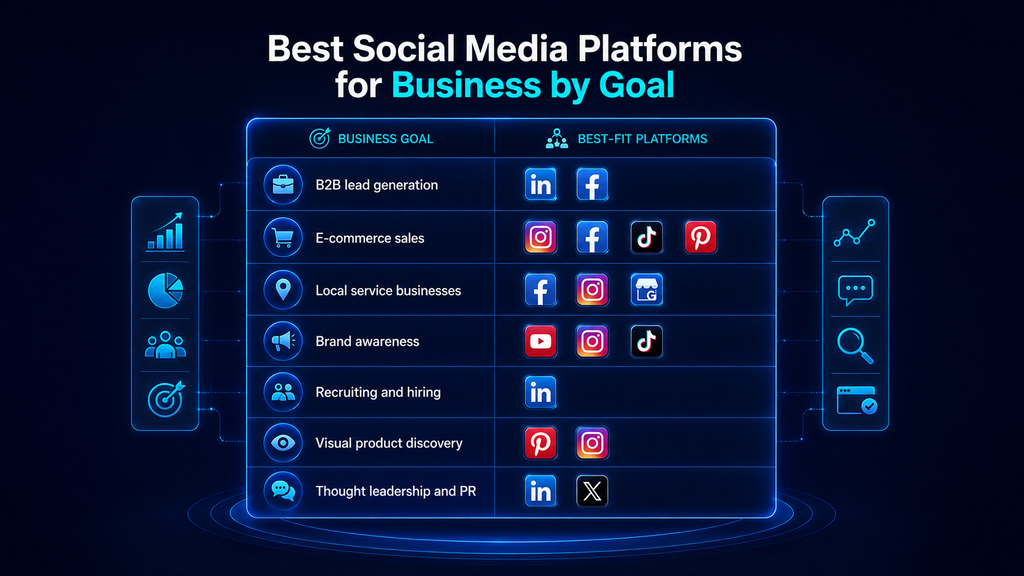
Different business goals often point toward different platforms. Here’s a quick reference to help match objectives with the right channel.
| Business Goal | Best-Fit Platforms |
| B2B lead generation | LinkedIn, Facebook |
| E-commerce sales | Instagram, Facebook, TikTok, Pinterest |
| Local service businesses | Facebook, Instagram, Google-connected platforms |
| Brand awareness | YouTube, Instagram, TikTok |
| Recruiting and hiring | |
| Visual product discovery | Pinterest, Instagram |
| Thought leadership and PR | LinkedIn, X |
This table isn’t a rigid rule, but it offers a useful starting point when narrowing down the best social media platforms for business based on your specific objective.
Common Mistakes Businesses Make When Choosing Social Media Platforms
Even experienced marketers sometimes fall into a few predictable traps when selecting social media platforms for business:
- Choosing based on personal preference rather than audience data. Just because you personally enjoy a platform doesn’t mean your customers spend time there.
- Trying to be everywhere at once. Spreading a small budget across five platforms often produces weaker results than focusing on one or two that genuinely fit your audience.
- Ignoring content production capacity. Choosing a video-heavy platform without the resources to consistently create video content leads to inconsistent, underperforming campaigns.
- Copying competitors without context. A platform that works for a competitor with a different budget, audience, or product isn’t automatically the right choice for your business.
- Never revisiting the decision. Audience behavior shifts over time, and the best social media platforms for business today may not be the best fit in a year or two.
How to Allocate Budget Across Social Media Platforms
Once you’ve identified which social media platforms for business make the most sense, the next question is how to split your budget if you’re considering more than one. A few practical approaches:
- The 70-20-10 rule. Allocate roughly 70% of your budget to your best-performing, proven platform, 20% to a secondary platform showing promise, and 10% toward testing a new channel.
- Start with a single platform. For businesses with limited budgets, concentrating spend on one of the best social media platforms for your audience, rather than splitting thin, generally produces more reliable, measurable results.
- Scale based on data, not assumptions. Once a platform proves profitable, gradually increase budget rather than jumping in with a large spend before you understand what’s actually working.
- Reassess quarterly. Platform performance shifts as algorithms change and audience behavior evolves, so revisiting your allocation every few months helps avoid wasted spend on a channel that’s quietly underperforming.
Can You Combine Multiple Social Media Platforms Effectively?
For many businesses, the answer isn’t choosing just one platform forever, but sequencing or combining social media platforms strategically as the business grows. A common approach looks like this:
- Start with one primary platform that best matches your audience and content strengths, and focus on proving profitability there first.
- Add a secondary platform for a different stage of the funnel. For example, using Instagram for awareness and retargeting website visitors through Facebook, or using YouTube for storytelling while LinkedIn handles direct B2B lead generation.
- Use retargeting across platforms. Someone who discovers your brand on TikTok might later see a retargeting ad on Instagram or Facebook, reinforcing the message across multiple touchpoints.
- Keep messaging consistent, but adapt the format. The core value proposition should stay the same across platforms, even as the creative format shifts to match each platform’s style and audience expectations.
This layered approach tends to work far better than trying to run identical campaigns across every platform simultaneously from day one.
Final Thoughts on Choosing the Right Social Media Platforms
Choosing the right social media platforms for business isn’t about picking the most popular option or the one everyone else seems to be using. It comes down to understanding your audience, your content capabilities, your budget, and your specific business goals, then matching those factors to the platform, or combination of platforms, most likely to deliver results.
If you’re unsure which of the best social media platforms for business fits your specific situation, or you’d rather not spend months testing through trial and error, that’s exactly where a dedicated digital marketing partner like Perform X Engine can help, identifying the right platforms and building campaigns designed to deliver measurable growth for your business.
Frequently Asked Questions About Social Media Platforms for Business
Which social media platforms are best for small businesses?
For most small businesses, Facebook and Instagram tend to offer the best balance of reach, targeting precision, and cost efficiency, making them a strong starting point among social media platforms for business.
What are the best social media platforms for B2B companies?
LinkedIn is generally considered the best social media platform for B2B advertising, since it allows precise targeting by job title, industry, and company size, though Facebook and X can also play a supporting role in a broader B2B strategy.
How many social media platforms should a business advertise on?
There’s no fixed number, but most businesses see stronger results focusing on one or two of the best social media platforms for their specific audience, rather than spreading a limited budget too thin across many channels at once.
Do the best social media platforms for business change over time?
Yes. Platform popularity, algorithm behavior, and audience demographics shift regularly, so it’s worth periodically reassessing whether your current platform choice still matches where your audience spends time.
Is it better to test multiple social media platforms before committing?
For businesses with the budget to do so, running small test campaigns across two or three platforms can be a useful way to gather real performance data before committing a larger, ongoing budget to one channel.