
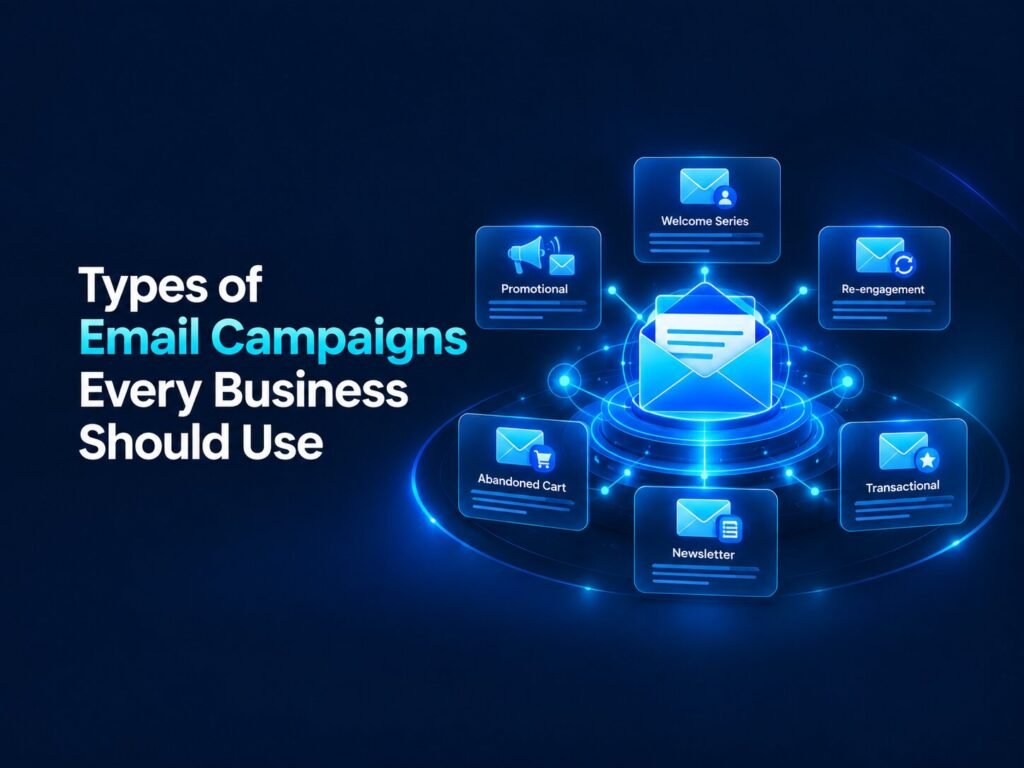
When we first started running email marketing for our clients at Perform X Engine, we made a mistake that a lot of businesses make. We sent the same kind of email to everyone, every single time. A new subscriber got the same message as someone who had already bought from us five times. The results were, honestly, disappointing.
It took us a while to realize the truth: email marketing is not one single tool. It is actually a toolbox filled with many different types of email marketing campaigns, and each one has its own job to do. Once we started using the right type of email at the right moment, our open rates, clicks, and sales all improved, sometimes dramatically.
In this guide, we want to share everything we have learned about the different types of email campaigns every business should be using. We will explain each one in simple, everyday language, share real examples, and tell you exactly when to use them. If you are a business owner exploring email marketing services, or just curious about how a strong email marketing campaign actually works behind the scenes, this guide is for you.
What Is an Email Marketing Campaign?
Before we go further, let’s keep it simple. An email marketing campaign is a planned email, or a series of emails, sent to your subscribers with one clear goal in mind. That goal could be to welcome a new customer, remind someone about an item left in their cart, share a special discount, or simply keep your brand fresh in someone’s mind.
The key word here is “planned.” A random email sent without a clear purpose is not really a campaign. A true email marketing campaign has a goal, a target audience, and a message built specifically to move that audience toward an action.
Why Understanding Different Types of Email Marketing Campaigns Matters
Here is something we tell every client during our first strategy call. If you only send one kind of email, you are leaving money on the table. Different subscribers are at different stages of their journey with your brand, and each stage needs a different message.
A brand new subscriber needs a warm welcome, not a hard sales pitch. A loyal customer who has not purchased in months needs a gentle nudge, not a generic newsletter. Someone who just abandoned their cart needs a quick, timely reminder, not a message that arrives two weeks later.
This is exactly why learning the different types of email marketing campaigns is so valuable. When you match the right email type to the right moment, your subscribers feel understood instead of spammed, and that is when real results start showing up in your open rates, click rates, and revenue.
The Two Main Categories of Email Campaigns
Through our own experience managing email marketing for clients across different industries, we have found it helpful to think of email campaigns in two big categories before diving into specific types.
Manual campaigns are emails you create and send by hand, at a specific time, to a specific list. Think newsletters, announcements, or a holiday sale blast.
Automated campaigns are emails that are built once and then triggered automatically based on what a subscriber does, like signing up, browsing a product, or making a purchase.
Both categories matter, and honestly, the strongest email marketing strategies we have built always use a healthy mix of both. Now, let’s walk through the actual types of email campaigns you should be using.
1. Welcome Email Campaigns
This is the very first email a new subscriber receives from your brand, and in our experience, it is one of the most important emails you will ever send. First impressions matter just as much in someone’s inbox as they do in real life.
A strong welcome email usually includes a warm thank you, a short introduction to your brand, and maybe a small incentive like a discount code to encourage a first purchase.
We have personally seen welcome emails get open rates far higher than regular newsletters, simply because the subscriber is still excited and paying attention right after signing up. If your business is not sending a proper welcome email today, this is the easiest win you can start with.
2. Newsletter Email Campaigns
Newsletters are the classic, ongoing email marketing campaign that keeps your brand present in your audience’s mind. These are usually sent weekly, biweekly, or monthly, and include a mix of updates, blog content, tips, or company news.
The biggest lesson we have learned about newsletters is that they should never feel like a sales pitch every single time. The businesses that keep subscribers engaged for years are the ones who genuinely share value, not just promotions, in almost every newsletter they send.
3. Promotional Email Campaigns
Promotional emails are built around one goal: driving quick action through a special offer, discount, or limited time deal. These are some of the highest converting types of email campaigns because they create urgency.
We have run promotional campaigns for clients around holidays, seasonal sales, and flash discounts, and the pattern is always the same. Clear subject lines, a strong deadline, and a simple call to action almost always outperform anything complicated.
4. Abandoned Cart Email Campaigns
If your business sells products online, this is one type of email marketing campaign you absolutely cannot skip. An abandoned cart email is triggered automatically when someone adds items to their cart but leaves without completing the purchase.
In our own client campaigns, we have consistently seen abandoned cart emails recover a meaningful percentage of “lost” sales, often just by reminding the customer what they left behind and gently addressing any hesitation, like adding a small discount or reassurance about shipping and returns.
5. Product Announcement Campaigns
When a business launches something new, whether it is a product, feature, or service, a product announcement email is the perfect way to build excitement. These campaigns usually include strong visuals, a clear description of what is new, and a reason for the subscriber to care.
We always recommend pairing product announcement emails with other channels, like social media, so the momentum builds across multiple touchpoints at once instead of relying on email alone.
6. Re-Engagement or Win-Back Campaigns
Every email list has subscribers who have gone quiet. They are not unsubscribing, but they are also not opening or clicking anymore. This is where win-back campaigns come in.
These types of email campaigns are designed to reignite interest, usually through a personal message, a special offer, or simply asking, “we miss you, is everything okay?” We have seen these campaigns bring back subscribers who had not engaged in over six months, which honestly still surprises us every time it works.
7. Post-Purchase and Onboarding Campaigns
The relationship with a customer does not end the moment they buy something. In fact, this is often when the real relationship begins. Post-purchase emails thank the customer, provide helpful information about their purchase, and set the stage for future loyalty.
For service based businesses, this often looks like an onboarding series that helps new customers get comfortable and successful with what they just signed up for. We have found that businesses who invest in this stage see noticeably lower refund rates and higher repeat purchases.
8. Upsell and Cross-Sell Campaigns
Once someone has already purchased or subscribed, it becomes much easier to introduce them to related products or upgraded plans. Upsell emails recommend a better version of what they already have, while cross-sell emails suggest complementary products.
Done carefully, these emails feel helpful, not pushy. Done poorly, they feel like a sales trap. The difference usually comes down to timing and relevance, something we always test carefully before scaling any campaign for a client.
9. Event Invitation Campaigns
If your business is hosting a webinar, workshop, or in-person event, event invitation emails are essential. These campaigns typically include the date, time, reason to attend, and a simple registration link.
We recommend sending at least two to three reminder emails leading up to the event, since a single invitation is easy to forget in a busy inbox.
10. Transactional Email Campaigns
Transactional emails are triggered by a direct action a customer takes, like placing an order, resetting a password, or confirming a booking. While these are not exactly marketing focused, they are still part of the full picture of email marketing campaigns, since they are a chance to reinforce trust and brand voice, even in something as simple as an order confirmation.
11. Seasonal and Holiday Campaigns
Seasonal campaigns are tied to specific times of year, like Black Friday, New Year, or back to school season. These campaigns work because they tap into a sense of timing and urgency that already exists in your customer’s mind.
We always tell clients to plan seasonal campaigns weeks in advance, since waiting until the last minute usually results in rushed messaging and missed opportunities.
12. Survey and Feedback Campaigns
Sometimes the goal of an email is not to sell anything at all. It is simply to listen. Survey and feedback emails ask customers about their experience, and this data becomes incredibly valuable for improving your product, service, or future campaigns.
We have used feedback campaigns to uncover issues we never would have noticed otherwise, directly from the people who matter most, our customers.
Comparison Table: Types of Email Campaigns and When to Use Them
| Type of Email Campaign | Best Used For | Example Trigger |
| Welcome Emails | First impression with new subscribers | New sign up |
| Newsletters | Ongoing engagement and brand presence | Weekly or monthly schedule |
| Promotional Emails | Quick sales and urgency | Sale or discount event |
| Abandoned Cart | Recovering lost online sales | Cart left without checkout |
| Product Announcements | Building buzz for something new | New launch |
| Win-Back Campaigns | Re-engaging inactive subscribers | Period of inactivity |
| Post-Purchase | Building loyalty after a sale | Completed purchase |
| Upsell and Cross-Sell | Increasing customer value | Existing purchase history |
| Event Invitations | Driving attendance | Upcoming event |
| Transactional Emails | Confirming an action | Order, booking, password reset |
| Seasonal Campaigns | Capturing timely demand | Holidays or seasons |
| Survey and Feedback | Gathering customer insights | Post interaction |
How to Choose the Right Types of Email Campaigns for Your Business
From our own experience building email strategies for clients, here is the simple approach we recommend. Start by mapping out your customer journey, from the moment someone signs up to the moment they become a repeat customer. Then ask yourself where the biggest gaps are.
If people sign up but never buy, focus on welcome and nurture emails. If people buy once and disappear, focus on post-purchase and win-back campaigns. If your list is growing but engagement is low, focus on newsletters that actually add value. You do not need every single type of email campaign running on day one. Start with two or three that match your biggest business need, then expand from there as you learn what works.
Email Marketing Campaigns and the Rise of AI Search (AEO, GEO, AIO)
Something we have noticed recently, both in our own research and in how our clients discover us, is that people are no longer only searching on Google. They are also asking AI tools like ChatGPT and Gemini, and using Google’s AI Overviews, to answer marketing questions directly.
This shift is exactly why we structured this guide the way we did. To rank well across traditional search, AI Overviews, and answer engines, content needs to follow a few simple principles, which we personally apply to everything we publish:
- Answer the core question early, so both readers and AI systems understand the topic immediately
- Use clear, descriptive headings that match how people naturally search, including question style headings
- Break information into short paragraphs, bullet points, and simple tables that are easy to scan and easy for AI tools to extract
- Cover the topic fully, including definitions, examples, and practical advice, instead of just scratching the surface
- Write in plain, honest language, based on real experience, which both readers and AI systems tend to trust more
This is the same approach we use for every piece of content on our own site, because we genuinely believe good marketing content should work for humans first, and search systems second.
Common Mistakes Businesses Make With Email Campaigns
Based on what we have seen across many client accounts, here are the most common mistakes businesses make with their email marketing campaigns:
- Sending the same type of email to every subscriber, regardless of where they are in their journey
- Ignoring automated campaigns like welcome series and abandoned cart emails, which often require almost no extra effort once set up
- Sending emails too frequently, which increases unsubscribes, or too rarely, which causes subscribers to forget your brand
- Never testing subject lines, send times, or content formats
- Treating email as a one way broadcast instead of an ongoing conversation with your audience
Final Thoughts From Our Team
If there is one thing we have learned from running email marketing campaigns for real businesses, it is this: email is not about sending more, it is about sending smarter. Understanding the different types of email marketing campaigns, and knowing exactly when to use each one, is what separates a brand that gets ignored from a brand that gets opened, clicked, and trusted.
Start small, pick the campaigns that solve your biggest gap right now, and build from there. That is exactly how we approach every email strategy we build at Perform X Engine, and it is an approach we would be happy to bring to your business too.
If you are ready to build a smarter, more strategic email marketing campaign for your business, our team at PerformXEngine is here to help you every step of the way.
Frequently Asked Questions About Email Marketing Campaigns
What are the main types of email marketing campaigns?
The main types of email marketing campaigns include welcome emails, newsletters, promotional emails, abandoned cart emails, product announcements, win-back campaigns, post-purchase emails, and transactional emails, among others.
What is the difference between manual and automated email campaigns?
Manual campaigns are created and sent by hand for a specific moment, like a holiday sale. Automated campaigns are built once and triggered automatically based on subscriber behavior, like signing up or abandoning a cart.
Which type of email campaign converts the best?
In our experience, abandoned cart emails and welcome emails usually have some of the highest conversion rates, since they are sent at a moment when the subscriber is already highly interested.
How many different types of email campaigns should a business use?
There is no fixed number, but most businesses benefit from starting with three to five core types of email campaigns, such as welcome, newsletter, promotional, and abandoned cart emails, before expanding further.
Are email marketing campaigns still effective today?
Yes. Email marketing remains one of the most reliable and cost effective digital marketing channels, especially when the right types of email campaigns are matched to the right stage of the customer journey.