
If you have spent any real time in SEO over the past few years, you have almost certainly run into the term E-E-A-T. It shows up in algorithm update discussions, content strategy meetings, and nearly every “how to rank in 2026” article published today. Yet despite how often it gets mentioned, a surprising number of SEO professionals still misunderstand what it actually is, and more importantly, how it actually works.
At PerformX Engine, we build E-E-A-T considerations directly into every content and SEO strategy we develop for clients, because ignoring it has become genuinely risky in an increasingly competitive, AI-saturated search landscape. In this guide, we will explain exactly what is eeat, break down each individual component, and walk through practical, real-world e-e-a-t best practices you can apply to your own content strategy or your clients’ websites.
What Is E-E-A-T?
Let’s start with a precise definition, since a lot of vague explanations exist online.
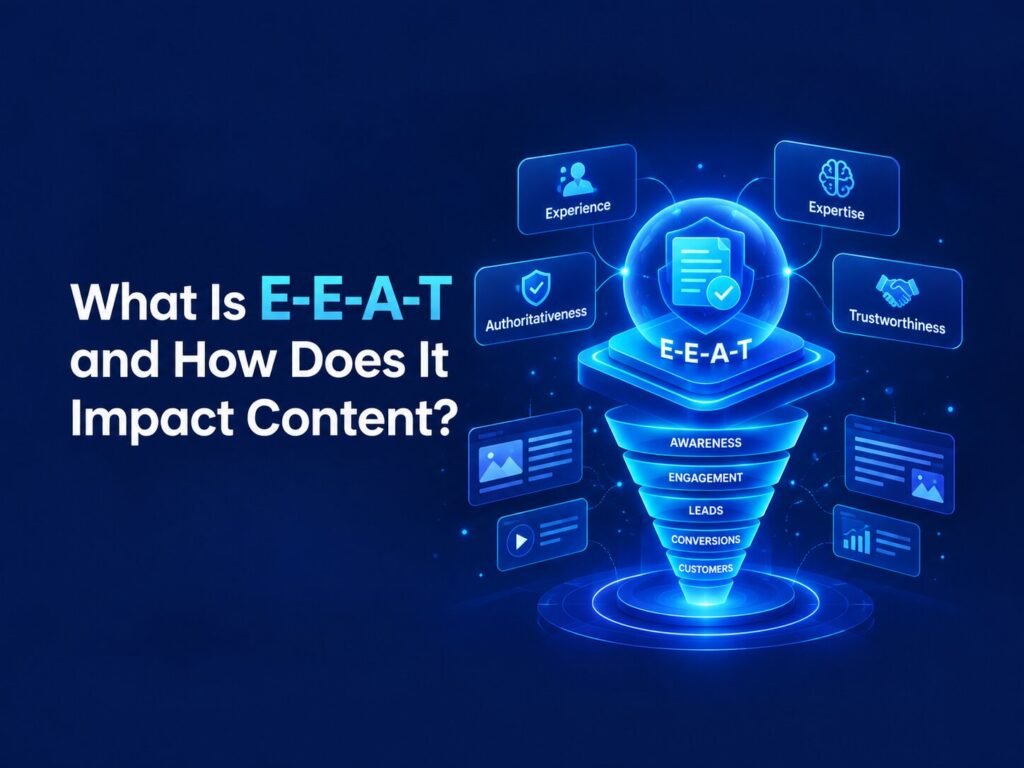
E-E-A-T stands for Experience, Expertise, Authoritativeness, and Trustworthiness. It originates from Google’s Search Quality Rater Guidelines, the internal handbook Google uses to train the human quality raters who evaluate search result quality. These human evaluations do not directly set individual page rankings, but they function as training data that helps refine and validate Google’s actual ranking algorithms over time.
So when someone asks what is eeat in seo, the precise answer is this: it is a content quality framework, not a single, measurable ranking factor. There is no “E-E-A-T score” that Google calculates and applies directly to your page. Instead, E-E-A-T represents a set of underlying qualities that Google’s actual algorithms attempt to detect and reward through many individual, indirect signals.
This distinction matters enormously for anyone working in SEO, because treating E-E-A-T as a literal, checkable ranking factor leads to superficial “optimization” tactics that miss the actual point entirely.
A Brief History: Why the Extra “E” Was Added
E-E-A-T did not always include the second “E.” The original concept, E-A-T, was first referenced in Google’s Search Quality Rater Guidelines back in 2014, covering Expertise, Authoritativeness, and Trustworthiness. In December 2022, Google added the additional “Experience” component, recognizing that content created by someone with genuine, firsthand experience with a topic carries a distinct kind of credibility that pure expertise alone does not fully capture.
Understanding this evolution matters, because it reveals something important about how Google’s guidelines change: not through radical overhauls, but through careful refinement of what quality actually means in practice. This also explains why some older content strategy advice, built purely around E-A-T, now feels incomplete without accounting for the experience component.
Breaking Down Each E-E-A-T Signal
Let’s go through each component individually, since understanding the nuance between them is where most surface-level explanations fall short.
Experience
Experience refers to whether the content creator has genuine, firsthand, real-world involvement with the topic they are writing about. This is distinct from expertise. A person can be a recognized expert in a subject without having personally experienced a specific situation, and someone can have deep, valuable experience without holding formal credentials.
For example, a product review written by someone who genuinely purchased and used the product carries a different kind of credibility than a review assembled entirely from secondhand research. This is exactly the kind of distinction the experience component was added to recognize.
Expertise
Expertise refers to the depth of knowledge and skill the content creator demonstrates on the specific topic. This can come from formal qualifications, professional experience, or demonstrated, in-depth understanding shown through the content itself. Expertise expectations vary significantly by topic; a casual blog post about a hobby requires far less formal expertise than a piece of medical or financial guidance.
Authoritativeness
Authoritativeness reflects how well-recognized the content creator, or the website publishing it, is within their specific field. This is often demonstrated through external validation, like being referenced or linked to by other reputable sources, industry recognition, or a track record of consistently reliable content on a particular topic.
Trustworthiness
Trustworthiness is widely considered the most important of the four e-e-a-t signals, since Google has explicitly stated that trust sits at the center of the entire framework. It reflects whether a website and its content are accurate, honest, safe, and transparent. This includes technical trust signals, like secure browsing and clear site ownership information, as well as content-level trust signals, like accurate information, proper sourcing, and transparency about potential conflicts of interest.
It is worth noting that even strong experience, expertise, and authoritativeness cannot fully compensate for weak trustworthiness. A page can appear highly expert and authoritative while still failing to earn genuine trust if it lacks transparency or contains inaccurate information.
Why E-E-A-T in SEO Matters More Than Ever
Understanding e-e-a-t in seo has become increasingly important for a specific, practical reason: the explosion of AI-generated content across the web. With a massive volume of low-effort, mass-produced content now being published daily, Google has strong incentive to more heavily reward content that demonstrably comes from real experience and genuine expertise, rather than generic, interchangeable text.
This shift also extends directly into AI-powered search features. AI Overviews and other AI-generated search results rely on trustworthy, well-sourced content to build accurate summaries. Content that demonstrates strong e-e-a-t signals is inherently more likely to be selected as a trusted source for these AI-generated answers, making this framework increasingly relevant well beyond traditional blue-link rankings.
Does E-E-A-T Matter for Every Type of Content?
E-E-A-T weighs most heavily on what Google refers to as YMYL content, meaning “Your Money or Your Life” topics, which include subjects like health, finance, legal guidance, and safety, where inaccurate information could cause real harm to a person’s wellbeing or financial situation. For these topics, Google’s quality raters apply significantly stricter scrutiny.
However, it is a common misconception that E-E-A-T only matters for YMYL content. In reality, these signals influence content quality assessment across nearly every topic, even if the practical stakes, and therefore the strictness of evaluation, are lower for something like a casual hobby blog compared to medical advice.
E-E-A-T Best Practices for Content and SEO Teams
Now let’s move into practical application. Here are proven e-e-a-t best practices you can implement across your content strategy.
1. Clearly Attribute Content to Real Authors
Include clear author bylines with genuine credentials, professional background, and relevant experience. Anonymous or vague authorship undermines trust signals significantly, especially for YMYL content.
2. Build Out Detailed Author Bio Pages
A dedicated author page that outlines a writer’s qualifications, experience, and professional background helps reinforce both expertise and authoritativeness across every piece of content they contribute.
3. Demonstrate Firsthand Experience Explicitly
Where genuinely applicable, show firsthand experience directly within the content itself, through original photos, specific personal insights, or details that only someone with real, hands-on experience would know.
4. Cite Credible, Authoritative Sources
Support factual claims with links to reputable, credible sources. This reinforces trustworthiness while also helping readers verify information independently.
5. Keep Content Accurate and Updated
Outdated or inaccurate information directly undermines trustworthiness. Establish a regular content review process to catch and correct outdated statistics, broken information, or claims that no longer hold up.
6. Strengthen Technical Trust Signals
Ensure your website uses secure browsing (HTTPS), provides clear contact information, includes a transparent “About Us” page, and clearly discloses any relevant business relationships or potential conflicts of interest.
7. Earn Genuine Authority Through External Recognition
Authoritativeness cannot be manufactured through internal claims alone. Focus on earning legitimate mentions, citations, and backlinks from respected, relevant sources within your specific industry.
8. Showcase Real Customer Reviews and Testimonials
For businesses, genuine customer reviews serve as a meaningful trust signal, both for Google’s assessment and for real visitors evaluating whether to trust your business.
Common E-E-A-T Mistakes to Avoid
- Treating E-E-A-T as a checklist rather than a genuine quality standard. Superficially adding author names or citations without real substance behind them rarely produces meaningful results.
- Assuming E-E-A-T only applies to YMYL topics. These quality signals influence content evaluation across nearly all topics, even if the scrutiny level varies.
- Neglecting technical trust signals. Strong content can still be undermined by a website that lacks basic security, transparency, or clear ownership information.
- Publishing content without genuine subject matter expertise behind it. Mass-produced, generic content without real depth struggles to demonstrate authentic expertise or experience.
- Ignoring content freshness and accuracy. Allowing outdated or inaccurate information to remain live directly damages trustworthiness over time.
How PerformXEngine Builds E-E-A-T Into Content Strategy
At PerformXEngine, we treat e-e-a-t signals as a foundational part of content strategy, not an afterthought applied after content is already written. Our approach typically includes:
- Ensuring every piece of content has clear, credible authorship with genuine relevant expertise
- Building detailed author profile pages that reinforce expertise and authoritativeness
- Incorporating original insight, genuine experience, and proper sourcing directly into content
- Auditing existing content regularly for accuracy and freshness
- Strengthening technical trust signals across client websites, from security to transparency
How E-E-A-T Relates to Google’s Helpful Content System
A common point of confusion among SEO professionals is how E-E-A-T relates to Google’s broader helpful content guidance. These are closely connected but not identical concepts. Google’s helpful content guidance focuses on whether content is genuinely created for people first, rather than primarily to manipulate search rankings. E-E-A-T, meanwhile, focuses specifically on the credibility and quality signals that indicate whether content, and the people or organizations behind it, can be trusted.
In practice, these two concepts reinforce each other. Content that is genuinely helpful, written by someone with real experience and expertise, tends to naturally demonstrate strong E-E-A-T signals as well. Conversely, content built primarily around ranking manipulation, regardless of how many author bios or citations are added superficially, tends to fail both standards simultaneously. Understanding this relationship helps content teams avoid treating E-E-A-T as an isolated checklist and instead view it as one part of a broader, unified quality standard Google applies across its ranking systems.
Final Thoughts
Understanding what is eeat, and applying genuine e-e-a-t best practices across your content strategy, has become essential in a search landscape increasingly shaped by AI-generated content and evolving AI search features. Rather than treating it as a checklist to satisfy, the strongest approach treats E-E-A-T as a reflection of genuine content quality, built through real experience, credible expertise, earned authority, and consistent trustworthiness.
At PerformX Engine, we help businesses build content strategies grounded in genuine e-e-a-t signals, positioning them for stronger performance across both traditional search and emerging AI search features. If you are ready to strengthen your content’s credibility and search visibility, our team is here to help.
Ready to build a content strategy grounded in real E-E-A-T? Reach out to PerformXEngine today and let’s strengthen your content’s credibility together.
Frequently Asked Questions About E-E-A-T
What is eeat in simple terms?
E-E-A-T stands for Experience, Expertise, Authoritativeness, and Trustworthiness. It is a content quality framework from Google’s Search Quality Rater Guidelines, used to help evaluate whether content is genuinely reliable and helpful.
Is e-e-a-t a direct Google ranking factor?
Not exactly. E-E-A-T is not a single, measurable ranking factor with a specific score. Instead, it represents underlying quality signals that Google’s actual ranking algorithms attempt to detect and reward indirectly.
What are the most important e-e-a-t signals to focus on first?
Trustworthiness is generally considered the most important of the four signals, since Google has stated it sits at the center of the entire framework, though all four components work together to build genuine content credibility.
Does e-e-a-t in seo matter for small businesses and niche websites?
Yes, while YMYL topics face stricter scrutiny, E-E-A-T principles influence content quality evaluation broadly, meaning even smaller or niche websites benefit from demonstrating genuine experience, expertise, and trustworthiness.
Can e-e-a-t signals be faked or shortcut?
No, genuine E-E-A-T cannot be effectively faked. Superficial tactics, like vague author credentials or citation-stuffing without real substance, rarely hold up, since these signals are meant to reflect authentic quality rather than surface-level markers.