
Have you ever scrolled through Instagram or Facebook so fast that you barely noticed the ads? You are not alone. People scroll through their feeds at lightning speed, which means your ad has less than a second or two to grab attention before someone swipes past it. This is exactly why meta ads creative matters so much.
At PerformX Engine, we have tested and managed hundreds of ad campaigns for businesses, and we can tell you one thing with total confidence: your targeting, your budget, and your bidding strategy can all be perfect, but if your creative is boring or forgettable, none of that will matter. The ad simply will not get noticed.
In this guide, we will explain everything about meta ad creative in simple, clear words. We will cover what makes an ad stand out, the meta ads creative best practices that actually work, common mistakes to avoid, and how to build ads that stop the scroll and turn viewers into customers.
Let’s dive in.
What Is Meta Ad Creative?
Meta ad creative refers to everything a person actually sees and hears when your ad appears in their Facebook or Instagram feed. This includes the image, video, text, headline, call to action button, and overall design and message of the ad.
Think of your targeting and bidding strategy as the “who” and “how much” of your campaign. Your meta ads creative is the “what,” meaning what the person actually experiences when your ad shows up. Even with perfect targeting, a weak or boring creative will get ignored, skipped, or scrolled right past.
This is why so many experienced marketers say creative is the real engine behind Meta advertising success. Meta’s own advertising system also rewards strong creative, because ads that get more engagement tend to perform better and often cost less to run.
Why Meta Ad Creative Matters So Much
Facebook and Instagram are built around fast, casual scrolling. Unlike Google Ads, where someone is actively searching for something, people on Meta platforms are usually just relaxing, catching up with friends, or watching short videos. They are not looking for your product. Your ad has to interrupt that scrolling in a good way and make them want to stop and look.
This is a completely different challenge compared to search advertising. A strong meta ad creative needs to:
- Grab attention within the first one to two seconds
- Feel natural and native to the platform, not like a traditional advertisement
- Clearly communicate a benefit or solve a problem quickly
- Encourage the viewer to take an action, like clicking, learning more, or buying
If your creative fails at any of these steps, even the best targeting in the world will not save your campaign.
The Building Blocks of Strong Meta Ad Creative
Let’s break down the different parts that make up a meta ad creative, since understanding each piece helps you build stronger ads overall.
1. The Hook
The hook is the very first thing someone sees or hears in your ad, usually within the first second or two. This could be a bold visual, an interesting question, a surprising statement, or a strong opening line in a video. If your hook does not grab attention immediately, the rest of your ad, no matter how good it is, will never get seen.
2. The Visual
Your image or video is the biggest factor in whether someone stops scrolling. Bright colors, clear subjects, real people, and simple, uncluttered designs tend to perform far better than busy, complicated visuals. Bold visuals almost always outperform overly polished, corporate looking graphics on Meta platforms.
3. The Message
Once you have someone’s attention, your message needs to explain the value clearly and quickly. What problem are you solving? What benefit will they get? This should be simple and easy to understand, not filled with jargon or long, complicated sentences.
4. The Call to Action (CTA)
Your call to action tells the viewer exactly what to do next, whether that is “Shop Now,” “Learn More,” or “Sign Up Today.” A clear, direct CTA removes confusion and makes it easy for someone to take the next step.
Meta Ads Creative Best Practices That Actually Work
Now let’s get into the practical, proven meta ads creative best practices that we use at PerformXEngine when building campaigns for our clients.
1. Design for Sound Off
Most people scroll through Facebook and Instagram with their sound turned off, especially in public places. Always add captions or on-screen text to your video ads so your message still comes through clearly, even without audio.
2. Keep Videos Short and Fast-Paced
Attention spans on social media are short. Aim to deliver your key message within the first five to ten seconds of a video ad. Fast cuts, quick transitions, and short clips usually perform better than long, slow-paced videos.
3. Use Native, Authentic-Looking Content
Ads that look like they belong in the feed, similar to a friend’s post or a creator’s video, tend to perform better than ads that look overly polished or clearly staged. This is why user-generated content (UGC) and creator-style videos have become such a powerful part of meta ad creative strategy in recent years.
4. Show the Product or Service in Action
Instead of just showing a static photo, show your product being used in a real situation. This helps viewers imagine themselves using it, which builds trust and interest far more effectively than a plain product shot alone.
5. Use Bold Text Overlays
Adding short, bold text directly on your image or video helps communicate your main message instantly, even for people who are scrolling quickly or watching without sound. Keep the text short, usually just a few words or a single short sentence.
6. Lead With the Benefit, Not the Feature
Instead of saying “Our software has advanced analytics,” say something like “See exactly where your ad budget is working.” Leading with the benefit connects with the viewer emotionally and makes the value instantly clear.
7. Test Multiple Creative Variations
Never rely on just one ad creative. Create several versions with different hooks, visuals, and messages, then let the data show you which one actually performs best. This is one of the most important meta ads creative best practices, because even experienced marketers cannot always predict which version will win.
8. Match Creative to the Platform and Placement
An ad designed for Instagram Stories should look different from an ad designed for the Facebook feed. Vertical video works best for Stories and Reels, while square or landscape formats often work better for feed placements. Adjusting your creative for each placement helps it feel natural rather than out of place.
9. Refresh Creative Regularly
Even a great performing ad will eventually experience something called ad fatigue, where the same audience sees the ad too many times and starts ignoring it. Refreshing your meta ad creative every few weeks helps keep performance strong and prevents this drop-off.
10. Keep Branding Clear but Not Overwhelming
Your brand should be recognizable, but it should not dominate the ad so much that it feels like a traditional, pushy advertisement. A light touch, like a small logo or consistent color scheme, works better than large branding elements plastered across the entire creative.
Types of Meta Ad Creative Formats
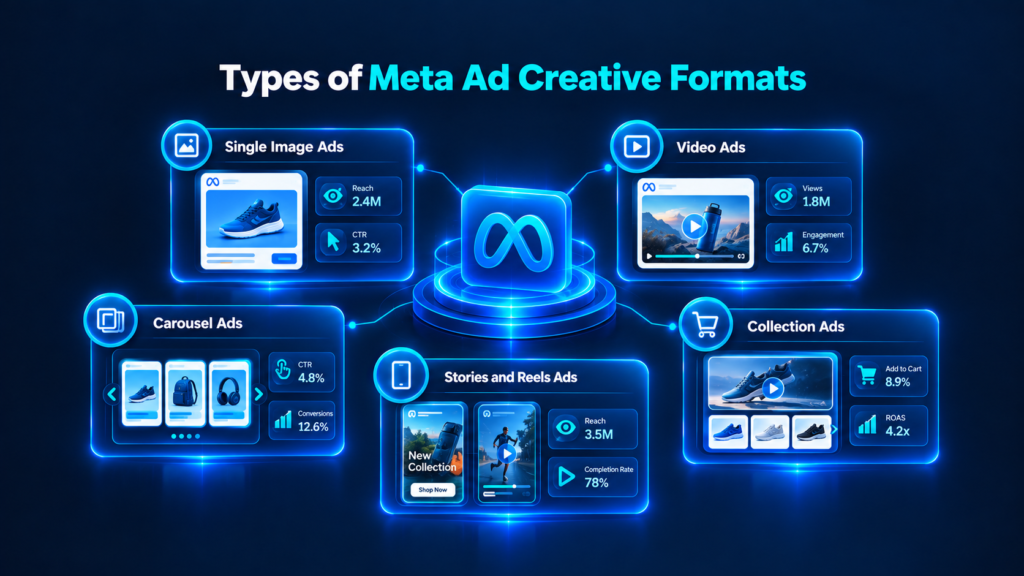
Understanding the different ad formats available helps you choose the right approach for your specific goals.
Single Image Ads
Simple and effective, single image ads work well for clear, direct offers or announcements. They are quick to create and easy to test in large numbers.
Video Ads
Video ads tend to capture more attention and can tell a more complete story than a static image. They work especially well for demonstrating products, sharing testimonials, or building emotional connection with your audience.
Carousel Ads
Carousel ads let you show multiple images or products in one ad, which viewers can swipe through. This format works well for ecommerce brands showcasing different products or for telling a step by step story.
Stories and Reels Ads
These full-screen, vertical ads appear between organic Stories and Reels content. Because they blend into the natural browsing experience, they need to feel casual and native rather than heavily produced.
Collection Ads
Collection ads combine a main video or image with a set of smaller product images below it, creating an interactive, catalog-style shopping experience directly inside the ad.
Common Meta Ad Creative Mistakes to Avoid
- Using overly polished, “stock photo” style visuals. These often blend in and get ignored because they do not feel authentic or native to the platform.
- Burying the message too deep in the ad. If someone has to watch for ten seconds before understanding what you are offering, you have already lost most of your audience.
- Ignoring captions and text overlays. Since most people scroll with sound off, skipping captions means losing a huge portion of your potential audience.
- Running only one ad creative for too long. This leads to faster ad fatigue and declining performance over time.
- Designing one creative for every placement. A single image forced into every placement often looks awkward, cropped incorrectly, or out of place.
- Focusing only on product features instead of real benefits. Features tell, but benefits sell, especially in a fast-scrolling social feed.
How to Build a Meta Ad Creative Strategy Step by Step
Here is a simple process you can follow to build strong, effective meta ad creative for your next campaign.
Step 1: Understand Your Audience
Before creating anything, understand who you are talking to. What do they care about? What problems are they trying to solve? A great creative always starts with a clear understanding of the audience.
Step 2: Plan Multiple Hooks
Write down several different hook ideas, whether it is a bold visual, a question, or a surprising statement. Testing multiple hooks is one of the fastest ways to find what truly grabs attention.
Step 3: Create a Mix of Formats
Build a mix of image ads, video ads, and carousel ads so you have a variety of formats to test across different placements and audiences.
Step 4: Keep the Message Simple
Write your ad copy and visuals around one clear, simple message. Avoid trying to communicate too many ideas in a single ad.
Step 5: Test, Measure, and Refresh
Launch your creative, monitor performance closely, and refresh your top-performing ads regularly to avoid fatigue. Use the data to guide your next round of creative decisions, rather than relying only on guesswork.
Why Professional Support Makes a Real Difference
Building strong meta ad creative takes more than just a nice looking image or video. It requires understanding audience psychology, platform behavior, and ongoing testing to find what truly works for your specific business. This is exactly the kind of work our creative and paid media team focuses on every day at PerformXEngine.
We help businesses design, test, and refine their meta ad creative strategy so their ads do not just get seen, they actually get results. From hook development to format testing to ongoing performance tracking, we treat creative as a core part of every successful Meta advertising campaign, not an afterthought.
Final Thoughts
Great meta ad creative is not about having the biggest budget or the most expensive production quality. It is about understanding your audience, grabbing attention within the first few seconds, and delivering a clear, simple message that encourages action. The businesses that consistently win with Meta advertising are the ones that treat creative as a core strategy, not a last-minute afterthought.
At PerformX Engine, we help businesses build meta ad creative that actually stands out in the feed and drives real results, not just impressions. If you are ready to stop blending in and start standing out, our team is here to help.
Ready to create Meta ads that actually get noticed? Reach out to PerformXEngine today and let’s build creative that stops the scroll.
Frequently Asked Questions About Meta Ad Creative
What is meta ad creative?
Meta ad creative refers to the actual images, videos, text, and design elements that a person sees when your ad appears in their Facebook or Instagram feed.
Why does meta ad creative matter more than targeting sometimes?
Even with perfect audience targeting, a weak or boring creative will get ignored or scrolled past. Strong creative is what actually grabs attention and convinces someone to take action.
What are the most important meta ads creative best practices?
Some of the most important best practices include designing for sound off with captions, keeping videos short and fast-paced, using authentic native-looking content, and testing multiple creative variations regularly.
How often should I refresh my meta ad creative?
Most advertisers should refresh their creative every few weeks to avoid ad fatigue, where the same audience sees the ad too often and starts ignoring it.
Should I use video or image ads on Meta platforms?
Both can work well depending on your goal. Video ads tend to build stronger engagement and storytelling, while image ads are quick and effective for simple, direct offers. A mix of both usually performs best.