
If you have ever done keyword research, you have probably stared at a spreadsheet full of numbers and wondered, “Should I pick the keyword with more searches, or the one that looks easier to rank for?” This one question confuses beginners and experienced marketers alike, and it all comes down to understanding keyword difficulty vs search volume.
At PerformX Engine, keyword research is one of the very first steps we work on with every client, because choosing the wrong keywords can waste months of effort on content that never ranks or never brings in the right visitors. In this guide, we will explain everything about keyword difficulty and search volume in simple, clear words. We will show you exactly how these two numbers work together, how to read them the right way, and how to find the best keyword opportunities for your website.
By the end of this blog, you will know exactly how to balance keyword difficulty and search volume so you can pick keywords that are actually worth your time.
What Is Search Volume?
Search volume is a number that tells you roughly how many times people search for a specific keyword, usually measured every month. If a keyword has a search volume of 5,000, that means about 5,000 people are typing that phrase, or something very close to it, into Google each month.
Search volume helps you understand demand. If nobody is searching for a topic, even a perfectly written page will not bring you much traffic. On the other hand, a keyword with a huge search volume tells you that a lot of people are interested in that topic.
But here is something important that many beginners miss: a bigger search volume number does not always mean a better keyword. Broad keywords with high search volume, like “marketing” or “shoes,” often carry unclear intent, meaning different people searching that word actually want very different things. This makes it harder to create one page that satisfies everyone searching for it.
How to Read Search Volume the Right Way
When you look at search volume, do not just ask “how big is this number?” Instead, ask these questions:
- Does this keyword match what my business actually offers?
- Is the search volume steady all year, or does it spike during certain seasons?
- Are people who search this keyword likely to click on a website result?
- Does this keyword fit naturally into my overall content plan?
Search volume is only useful when it is paired with the right context, which brings us to the second half of this comparison.
What Is Keyword Difficulty?
Keyword difficulty is a score, usually shown as a number between 0 and 100, that estimates how hard it might be to rank on the first page of Google for a specific keyword. A low keyword difficulty score suggests it may be easier to rank, while a high keyword difficulty score suggests the competition is much tougher.
SEO tools calculate keyword difficulty by looking at the websites that are already ranking for that keyword. They study things like how many backlinks those pages have, how strong and trusted those websites are, and how well optimized the content already ranking happens to be.
It is important to understand that keyword difficulty is an estimate, not an exact science. Different SEO tools often show slightly different difficulty scores for the same keyword, because each tool uses its own formula and data sources. This is why keyword difficulty should be used as a helpful guide, not as the final word on whether a keyword is worth targeting.
How to Read Keyword Difficulty the Right Way
Instead of only looking at the difficulty number, check these details too:
- Are the websites currently ranking large, well known brands, or smaller sites like yours?
- Do the top ranking pages actually answer the search well, or is there room to create something better?
- How many strong backlinks do the top ranking pages have?
- Is your own website currently strong enough to compete for this keyword right now?
A keyword with a “high” difficulty score is not always impossible, and a keyword with a “low” difficulty score is not always easy. The real answer depends on your website’s current strength compared to the competition already ranking.
Keyword Difficulty vs Search Volume: The Key Difference
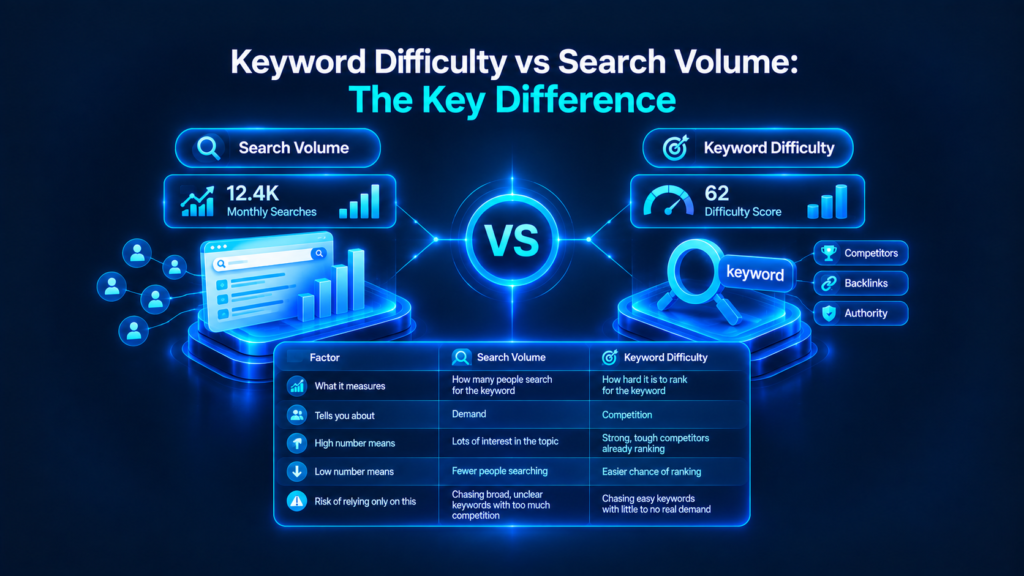
Now let’s put these two ideas side by side, because understanding keyword difficulty vs search volume is really about understanding two very different questions.
- Search volume answers: How many people are searching for this?
- Keyword difficulty answers: How hard will it be to rank for this?
One measures demand. The other measures competition. A smart keyword strategy never looks at just one of these numbers alone. Instead, it looks at both together, along with a third factor we will cover shortly: search intent.
Simple Comparison Table
| Factor | Search Volume | Keyword Difficulty |
| What it measures | How many people search the keyword | How hard it is to rank for the keyword |
| Tells you about | Demand | Competition |
| High number means | Lots of interest in the topic | Strong, tough competitors already ranking |
| Low number means | Fewer people searching | Easier chance of ranking |
| Risk of relying only on this | Chasing broad, unclear keywords with too much competition | Chasing easy keywords with little to no real demand |
The Keyword Opportunity Matrix: Combining Both Metrics
One of the easiest ways to actually use keyword difficulty and search volume together is to think of them as a simple two by two matrix. This helps you quickly sort keywords into four clear groups.
1. High Search Volume, Low Keyword Difficulty (Best Opportunities)
These are the golden keywords. Lots of people are searching, and the competition is not too strong. These keywords should be at the very top of your priority list, because they offer the biggest reward with the smallest amount of risk.
2. High Search Volume, High Keyword Difficulty (Long-Term Goals)
These keywords have great demand, but strong, established competitors already dominate the results. They are worth targeting eventually, especially once your website builds more authority, but they usually should not be your very first priority, especially if your website is new.
3. Low Search Volume, Low Keyword Difficulty (Quick Wins)
These keywords do not bring huge traffic on their own, but they are easy to rank for. They are perfect for newer websites that need to build momentum, authority, and trust with search engines before going after bigger, more competitive terms.
4. Low Search Volume, High Keyword Difficulty (Usually Avoid)
These keywords offer very little reward and a lot of competition. In most cases, it is best to avoid spending time and resources here unless the keyword is directly tied to a very important business goal.
This simple framework takes the confusing keyword difficulty vs search volume debate and turns it into a practical, easy decision-making tool.
Why Search Intent Also Matters
While this blog focuses on keyword difficulty vs search volume, there is a third piece of the puzzle that ties everything together: search intent. Search intent simply means understanding what the person searching actually wants.
For example, someone searching “digital marketing” might want a definition, a course, or an agency to hire. Someone searching “affordable digital marketing agency for small business” clearly wants to hire a company. Even if both keywords had the exact same search volume and keyword difficulty, the second one would likely bring far better results, because the intent behind it is crystal clear.
Always ask yourself what the searcher truly wants before creating content around a keyword, no matter how good its search volume or keyword difficulty numbers look on paper.
How to Choose the Right Keywords Using Both Metrics
Here is a simple, step by step process you can follow.
Step 1: Build a List of Relevant Keywords
Start with keywords that are directly related to your business, products, or services. Use keyword research tools to expand this list with related terms, questions, and variations.
Step 2: Check the Search Volume
Look at the search volume for each keyword to understand how much demand exists. Remove keywords that have almost no search volume unless they serve a very specific, important purpose for your business.
Step 3: Check the Keyword Difficulty
Look at the keyword difficulty score for each remaining keyword. Compare it honestly against your website’s current authority and strength.
Step 4: Review Search Intent
Search the keyword yourself and look at what is currently ranking. Make sure the type of content ranking, like blog posts, product pages, or comparison guides, matches what you plan to create.
Step 5: Prioritize Using the Opportunity Matrix
Sort your keyword list using the four category matrix explained above. Start with high volume, low difficulty keywords, then move to quick win keywords, and save the toughest, high difficulty keywords for later as your website grows stronger.
Common Mistakes When Comparing Keyword Difficulty and Search Volume
- Chasing only high search volume keywords. This often leads to picking broad, highly competitive terms that a new website simply cannot rank for yet.
- Ignoring keyword difficulty completely. Without checking difficulty, you may spend months creating content for keywords that are nearly impossible to rank for.
- Trusting keyword difficulty as an exact science. Difficulty scores are estimates that can vary between tools, so always double check the actual search results yourself.
- Ignoring search intent. A keyword can have perfect search volume and difficulty numbers and still fail if the content does not match what searchers actually want.
- Never revisiting keyword choices. Search volume and competition levels change over time, so keyword research should be reviewed and updated regularly.
Why This Matters for Long-Term SEO Growth
Understanding keyword difficulty vs search volume is not just a one-time research task. It shapes your entire content strategy over time. Websites that build a smart mix of easy quick-win keywords, along with a long-term plan to target bigger, more competitive keywords, tend to grow steadily and sustainably, instead of chasing big numbers that never actually convert into traffic or customers.
This is exactly the kind of balanced approach our team follows at PerformXEngine. We do not just chase the biggest search volume numbers. We build a realistic, research backed keyword strategy that matches your website’s current strength today while planning for stronger growth tomorrow.
Final Thoughts
Choosing the right keywords is never just about picking the biggest search volume number or the smallest keyword difficulty score. The real skill lies in understanding how keyword difficulty and search volume work together, alongside a clear understanding of search intent, to find keywords that are genuinely worth your time and effort.
At PerformX Engine, we help businesses build smart, realistic keyword strategies that balance demand and competition, so every piece of content has a genuine chance to rank and bring in real customers. If you are ready to stop guessing and start choosing the right keyword opportunities, our team is here to help.
Ready to find the best keyword opportunities for your business? Reach out to PerformXEngine today and let’s build a smarter SEO strategy together.
Frequently Asked Questions About Keyword Difficulty vs Search Volume
What is the difference between keyword difficulty and search volume?
Search volume measures how many people search for a keyword, while keyword difficulty measures how hard it may be to rank for that keyword. One shows demand, the other shows competition.
Should I choose keywords with high search volume or low keyword difficulty?
The best keywords usually balance both. Look for keywords with decent search volume and manageable keyword difficulty, rather than chasing one metric alone.
Is a low keyword difficulty score always a good sign?
Not always. Some low difficulty keywords have very little search volume or unclear intent, which means they may not bring meaningful traffic or business value.
Can keyword difficulty scores be wrong?
Keyword difficulty is an estimate calculated by SEO tools, and different tools can show different scores for the same keyword. It is best used as a general guide, not an exact measurement.
How often should I check search volume and keyword difficulty?
It is a good idea to review your keyword strategy every few months, since search behavior, competition, and keyword difficulty scores can change over time.