
Most businesses that struggle to get results from Google Ads aren’t failing because of a small budget or bad luck. More often than not, the real problem is a messy, disorganized account. A poor google ads account structure quietly wastes budget, confuses Google’s algorithm, and makes it nearly impossible to figure out what’s actually working, even when the ads themselves are well written and the offer is genuinely strong.
In this guide, we’re breaking down exactly how a Google Ads account is organized, from the top-level account down to individual keywords and ads, so you understand how everything fits together and why structure matters just as much as the ads themselves. Whether you’re setting up your very first campaign or trying to make sense of an account that’s grown messy over time, understanding this hierarchy is the starting point for real, lasting improvement.
What Is Google Ads Account Structure?
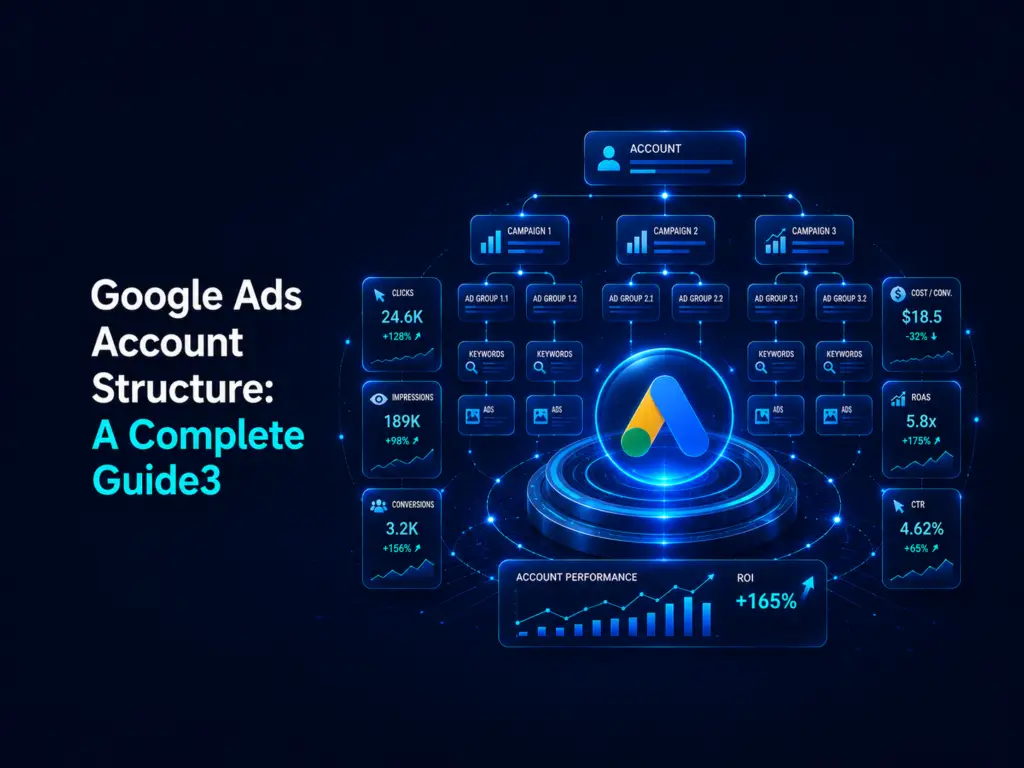
Google Ads account structure refers to the way an account is organized into a clear hierarchy: Account, then Campaigns, then Ad Groups, then Keywords and Ads within each group. Think of it like a filing system. Everything needs a logical place, or the whole system becomes difficult to manage and even harder to optimize.
A well-planned google ads account structure makes it easy to control budgets, target the right audience, write relevant ad copy, and clearly measure performance. A poorly planned one leads to wasted spend, irrelevant ads showing for the wrong searches, and reporting data that’s too tangled to actually learn from.
The Four Levels of Google Ads Account Structure
To understand how everything connects, it helps to walk through each level of the hierarchy individually, since every layer plays a specific role in a well-organized google ads account structure.
1. The Account Level
This is the top of the structure, essentially your business’s entire Google Ads presence. A single account can contain multiple campaigns, and it holds account-wide settings such as billing information, linked Google Analytics and Google Search Console properties, conversion tracking, and overall account access permissions.
For most small and mid-sized businesses, one account is enough. Larger businesses with multiple brands, locations, or business units sometimes use a Google Ads Manager Account (MCC) to oversee several individual accounts from a single dashboard.
2. The Campaign Level
Campaigns sit just below the account level, and this is where your budget and overall strategy get defined. Each campaign has its own daily budget, targeting settings (location, language, device), campaign type (Search, Display, Shopping, Video, Performance Max), and bidding strategy.
Campaigns are typically organized around a broader business goal or product category. For example, an e-commerce store might run separate campaigns for “Men’s Shoes,” “Women’s Shoes,” and “Accessories,” each with its own budget and targeting settings tailored to that category.
3. The Ad Group Level
Inside each campaign, you’ll find ad groups, which is where things get more specific. Ad groups organize closely related keywords and the ads that correspond to them. A tightly themed ad group ensures that when someone searches a specific term, the ad they see feels directly relevant to what they’re looking for.
For example, within a “Men’s Shoes” campaign, you might have separate ad groups for “Running Shoes,” “Formal Shoes,” and “Sneakers,” each containing keywords and ads specific to that shoe type. This level of organization is one of the most important parts of a strong google ads account structure, since it directly affects Quality Score and ad relevance.
4. Keywords and Ads
At the most granular level, each ad group contains the actual keywords you’re bidding on and the ads that will display when those keywords are triggered by a search. Keeping keywords tightly grouped by theme, and writing ad copy that closely matches those keywords, is what creates a smooth, relevant experience from search query to ad to landing page.
Why Google Ads Account Structure Matters So Much
A thoughtful google ads account structure isn’t just about staying organized for its own sake. It directly impacts your results in several important ways:
- Better Quality Score. Tightly themed ad groups with relevant keywords and matching ad copy tend to earn higher Quality Scores, which can lower your cost per click and improve ad position.
- Clearer performance data. A logical structure makes it easy to see exactly which campaigns, ad groups, or keywords are driving results, and which ones are wasting budget.
- Easier budget control. Separating campaigns by product line, service, or goal lets you allocate spend precisely where it performs best.
- More relevant ads. Closely grouped keywords allow you to write highly specific ad copy, which improves click-through rates and conversion rates.
- Simpler long-term management. As your account grows, a clean structure makes it far easier to add new campaigns, pause underperforming ones, and scale what’s working.
Common Google Ads Account Structure Mistakes to Avoid
Many businesses unintentionally set up a messy account structure early on, which creates problems down the line. Here are a few of the most common mistakes:
- Cramming too many keywords into one ad group. This makes it impossible to write ad copy that’s relevant to every search term, hurting both relevance and Quality Score.
- Mixing unrelated products or services in a single campaign. This makes budget control and performance tracking far more difficult.
- Ignoring match types. Using only broad match keywords without proper structure can lead to irrelevant traffic and wasted spend.
- Not separating campaigns by goal. Combining brand awareness and direct-response goals in the same campaign makes it hard to optimize for either one effectively.
- Neglecting negative keywords. Without a clear negative keyword strategy at the campaign or ad group level, ads can show for irrelevant searches, draining budget quickly.
- Overcomplicating the structure. On the opposite end, some businesses create far too many campaigns and ad groups, spreading budget too thin to gather meaningful data.
Best Practices for Building a Strong Google Ads Account Structure
If you’re setting up a new account or restructuring an existing one, these best practices will help you build a foundation that supports long-term performance:
- Organize campaigns around clear business goals or product categories, so each one has its own focused budget and strategy.
- Keep ad groups tightly themed, ideally with 5 to 20 closely related keywords per group.
- Match ad copy directly to the keywords in each ad group, so the message feels specific and relevant to the search.
- Use Single Keyword Ad Groups (SKAGs) for high-value terms, when precise control over a specific keyword’s performance matters most.
- Apply negative keywords at both the campaign and account level, to filter out irrelevant traffic before it drains your budget.
- Separate campaigns by network and device performance, when data shows a clear difference in results between mobile and desktop, or Search versus Display.
- Review and refine your structure regularly, since a structure that worked at launch may need adjustment as your account gathers more performance data.
Different Approaches to Google Ads Account Structure
There isn’t just one “correct” way to organize an account. Depending on your business size, goals, and how much time you can dedicate to ongoing management, a few different structural approaches to google ads account structure are commonly used.
Single Keyword Ad Groups (SKAGs)
This approach places just one keyword (often in a few match type variations) into its own dedicated ad group. The main advantage is precise control: you can write ad copy that matches that exact keyword almost perfectly, which often improves relevance and Quality Score. The trade-off is that SKAGs can become time-consuming to manage at scale, since a large keyword list means a large number of individual ad groups.
Single Theme Ad Groups (STAGs)
Instead of isolating a single keyword, this approach groups a handful of closely related keywords, typically five to twenty, under one shared theme. It offers a good balance between relevance and manageability, and it’s the approach most small and mid-sized businesses find easiest to maintain over time.
Performance Max and Automated Structures
Newer, AI-driven campaign types like Performance Max shift some of this structural control to Google’s machine learning systems, using asset groups instead of traditional ad groups. While this reduces manual structuring work, it still benefits from a business providing clear, well-organized inputs, such as distinct audience signals and asset groups organized by product category, rather than lumping everything into one broad group.
Choosing between these approaches often comes down to how much hands-on control you want versus how much time you can realistically dedicate to ongoing account management. Many businesses start with a STAG-based google ads account structure and shift toward SKAGs for their highest-value keywords once they have enough data to justify the extra granularity.
A Simple Example of Google Ads Account Structure in Action
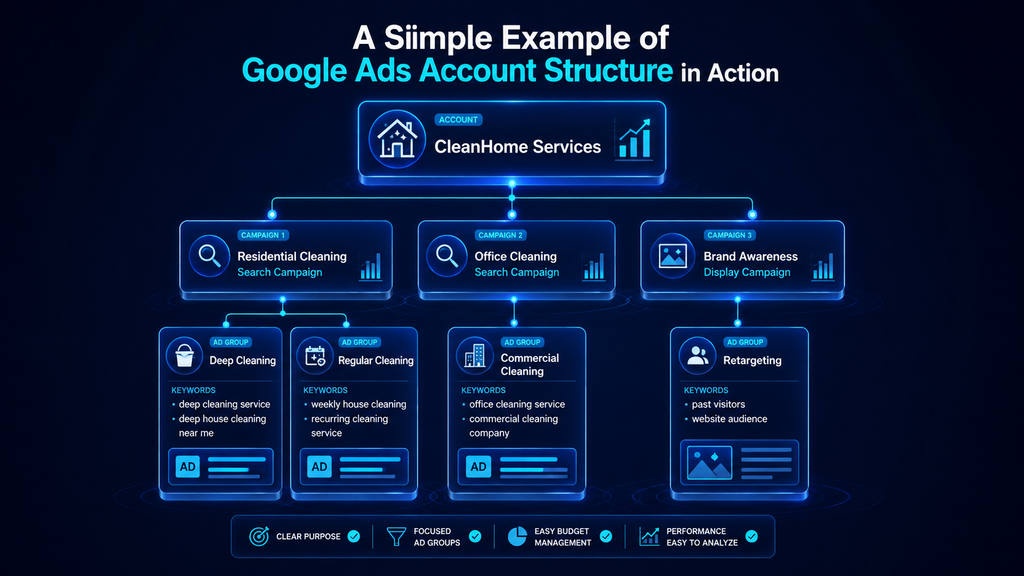
To bring this together, here’s a simplified example for a fictional local business, a home cleaning company:
- Account: CleanHome Services
- Campaign 1: Residential Cleaning (Search)
- Ad Group: Deep Cleaning → Keywords: “deep cleaning service,” “deep house cleaning near me” → Ad copy focused on deep cleaning
- Ad Group: Regular Cleaning → Keywords: “weekly house cleaning,” “recurring cleaning service” → Ad copy focused on recurring plans
- Campaign 2: Office Cleaning (Search)
- Ad Group: Commercial Cleaning → Keywords: “office cleaning service,” “commercial cleaning company” → Ad copy focused on business clients
- Campaign 3: Brand Awareness (Display)
- Ad Group: Retargeting → Visuals and messaging aimed at past website visitors
- Campaign 1: Residential Cleaning (Search)
Notice how each campaign has a clear, distinct purpose, and each ad group inside it stays tightly focused on one specific theme. This is exactly the kind of google ads account structure that makes budgets easier to manage and performance easier to analyze.
Final Thoughts on Google Ads Account Structure
A strong google ads account structure isn’t a minor technical detail, it’s the foundation everything else in your campaigns is built on. Clear campaigns, tightly themed ad groups, relevant keywords, and closely matched ad copy all work together to improve Quality Score, control spend, and make your performance data genuinely useful.
If you’re setting up your first account or suspect your existing structure might be holding your results back, that’s exactly where a dedicated digital marketing partner like Perform X Engine can help, building or refining your google ads account structure into a clean, scalable foundation for consistent leads and sales.
Frequently Asked Questions About Google Ads Account Structure
What is the correct google ads account structure for a small business?
Most small businesses do well with one account, a small number of campaigns organized by product or service category, and tightly themed ad groups within each campaign, typically five to fifteen closely related keywords per group.
How many campaigns should a Google Ads account have?
There’s no fixed number. The right count depends on how many distinct products, services, or goals your business is advertising, but each campaign should have a clear, separate purpose and its own budget.
What’s the difference between a campaign and an ad group?
A campaign controls overall budget, targeting, and strategy, while an ad group sits inside a campaign and organizes a specific set of closely related keywords and the ads tied to them.
Does google ads account structure affect Quality Score?
Yes. A tightly organized structure, with relevant keywords grouped closely together and ad copy that matches them, directly supports higher Quality Scores, which can lower costs and improve ad position.
Should I restructure an existing Google Ads account?
If your current account has mixed themes within ad groups, unclear campaign goals, or performance data that’s difficult to interpret, restructuring is often worth the short-term effort for long-term clarity and better results.