
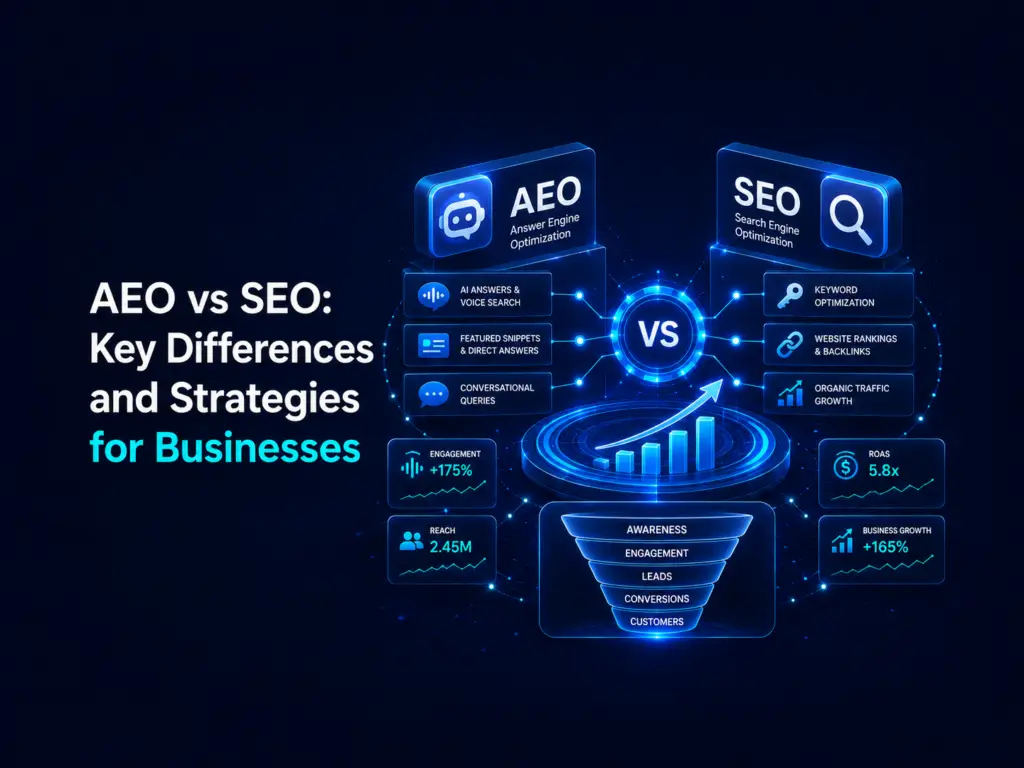
If you’ve been keeping up with digital marketing trends lately, you’ve probably noticed a new term popping up alongside the familiar one: AEO. And if you’re a business owner who finally got comfortable with SEO, you might be wondering whether you now need to learn an entirely new strategy from scratch. That’s exactly what this guide is here to clear up: aeo vs seo, what each one actually means, how they differ, and why understanding both matters for your business going forward.
This is a pillar page, which means we’re covering every major concept related to aeo vs seo here, briefly and practically, so you get a complete picture. In the coming weeks, we’ll publish detailed guides on each subtopic linked from this page, going deeper into AEO strategy, structured data, and answer-focused content creation.
What Is AEO vs SEO? Starting With the Definitions
Before comparing the two, let’s define them individually, since understanding what is aeo vs seo starts with knowing what each term actually stands for.
SEO (Search Engine Optimization) is the practice of improving a website so it ranks higher in traditional search engine results, like Google or Bing, when people search using keywords. The goal is to drive organic traffic to your website by appearing among the list of blue links on a search results page.
AEO (Answer Engine Optimization) is the practice of optimizing content so it gets pulled directly into AI-generated answers, featured snippets, voice assistant responses, and chatbot tools like ChatGPT, Google’s AI Overviews, and Perplexity. Instead of aiming to rank as a link, AEO aims to become the actual answer itself.
So, what is aeo vs seo in one sentence? SEO gets your website found through search results, while AEO gets your content quoted, summarized, or directly presented as the answer, often without the user ever clicking through to a website at all.
Why AEO vs SEO Has Become Such an Important Conversation
The reason aeo vs seo has become such a hot topic isn’t just a marketing trend, it reflects a real shift in how people search for information. Search behavior is evolving rapidly:
- More users are asking full questions to AI tools instead of typing short keyword phrases into Google.
- Google itself now shows AI Overviews at the top of many search results, answering questions directly before a single website link appears.
- Voice assistants like Siri, Alexa, and Google Assistant pull single, spoken answers rather than a list of options.
- Younger audiences increasingly use platforms like ChatGPT as a starting point for research, rather than a traditional search engine.
For business owners, this means visibility isn’t just about ranking on page one anymore. It’s also about being the source that AI tools trust enough to quote or summarize when answering a customer’s question.
AEO vs SEO Differences: How the Two Actually Compare
Let’s break down the core aeo vs seo differences so you can see exactly where these strategies overlap and where they diverge.
1. The Goal
SEO aims to rank your webpage as high as possible in traditional search results. AEO aims to have your content selected as the direct answer, whether that’s in a featured snippet, an AI Overview, or a voice assistant’s spoken response.
2. The Content Format
SEO content is often built around comprehensive, keyword-optimized pages designed to satisfy a broad search intent. AEO content is built around clear, concise, directly answerable statements, often structured as questions and short, well-defined answers.
3. The User Outcome
With SEO, success typically means a user clicks through to your website. With AEO, success often means your brand or information is presented as the answer, sometimes without any click at all, which shifts the focus from clicks toward brand visibility and trust.
4. Technical Requirements
SEO relies heavily on backlinks, page speed, keyword placement, and site structure. AEO leans more heavily on structured data (schema markup), clear headings, FAQ formatting, and content that directly answers specific questions in plain language.
5. Measurement
SEO success is commonly measured through rankings, organic traffic, and click-through rates. AEO success is harder to measure directly, since it often involves impressions and brand mentions within AI-generated answers rather than traditional click-based metrics.
Understanding these aeo vs seo differences is the first step toward building a strategy that accounts for both, rather than treating one as a replacement for the other.
Where AEO and SEO Actually Overlap
Despite their differences, aeo vs seo isn’t really an either-or decision. In fact, the two strategies share a surprising amount of common ground.
- Both rely on genuinely useful, high-quality content. AI answer engines and traditional search engines both prioritize content that clearly and accurately addresses a user’s question.
- Both benefit from strong website authority. Backlinks, brand mentions, and credibility signals help both traditional rankings and the likelihood of being cited in AI-generated answers.
- Both require technical health. A fast, mobile-friendly, well-structured website supports both SEO rankings and AEO visibility.
- Both depend on understanding user intent. Whether someone is typing a keyword or asking an AI assistant a full question, the underlying goal is the same: solving their problem.
In short, strong SEO fundamentals actually make AEO easier to achieve, which is good news for businesses that have already invested time in building a solid organic presence.
AEO vs SEO Strategy: What Businesses Should Actually Do
Since this is a pillar page, we won’t go deep into implementation here, but here’s a short overview of how businesses can start approaching aeo vs seo strategically, rather than treating them as competing priorities.
1. Keep Investing in Core SEO
Solid on-page SEO, technical health, and backlink building remain essential. AEO doesn’t replace SEO, it builds on top of it.
2. Structure Content Around Direct Questions
Add clear FAQ sections, use question-based subheadings, and answer them in concise, direct language that’s easy for AI tools to extract and summarize.
3. Use Structured Data (Schema Markup)
Implementing schema markup helps search engines and AI tools understand your content’s context, making it easier to surface in rich results and AI-generated answers.
4. Focus on E-E-A-T (Experience, Expertise, Authoritativeness, Trustworthiness)
AI answer engines tend to favor content from sources that demonstrate real expertise and credibility, which makes author bios, citations, and original data increasingly valuable.
5. Monitor AI Visibility, Not Just Rankings
Start tracking whether your brand or content appears in AI Overviews, ChatGPT responses, or voice assistant answers, in addition to traditional keyword rankings.
How to Measure Success Across Both AEO and SEO
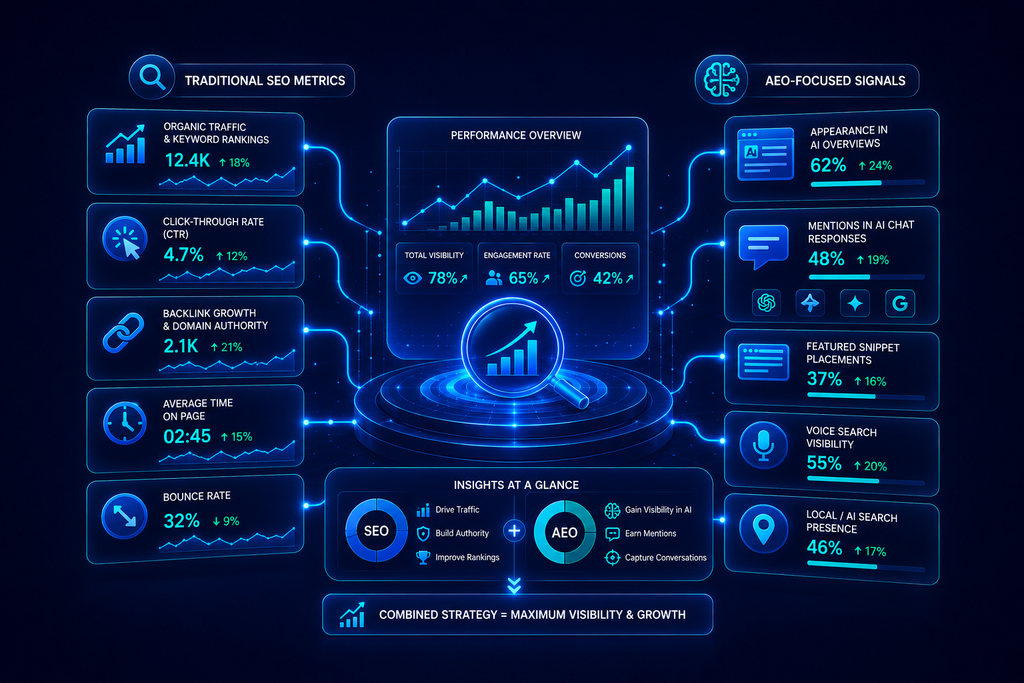
Since aeo vs seo requires slightly different ways of thinking about performance, it helps to know what to actually track for each.
Traditional SEO metrics to monitor:
- Organic traffic and keyword rankings
- Click-through rate (CTR) from search results
- Backlink growth and domain authority
- Bounce rate and average time on page
AEO-focused signals to start tracking:
- Whether your content appears in Google’s AI Overviews for relevant queries
- Mentions or citations in AI chatbot responses (ChatGPT, Perplexity, Gemini, and similar tools)
- Featured snippet placements for question-based searches
- Voice search visibility for local or informational queries
Most businesses are still early in figuring out reliable ways to track AEO performance, since the tools for measuring AI visibility are newer and less standardized than traditional analytics. Even so, periodically searching your own target questions across AI tools, and noting whether your business shows up, is a simple way to get a sense of where you currently stand.
A Quick Side-by-Side Snapshot
To bring the entire aeo vs seo comparison together in one place, here’s a simplified snapshot business owners can use as a quick reference:
| Factor | SEO | AEO |
| Primary goal | Rank high in search results | Become the direct answer |
| Where it appears | Search engine results pages | AI Overviews, snippets, voice answers, chatbots |
| Content style | Comprehensive, keyword-optimized pages | Concise, question-and-answer format |
| Key technical factor | Backlinks, site speed, on-page SEO | Structured data, clear headings, direct answers |
| Success metric | Organic traffic, rankings, CTR | AI citations, snippet placements, brand mentions |
This table isn’t meant to suggest you should choose one column over the other. Instead, it’s a reminder that a modern digital marketing strategy needs to account for both sides of aeo vs seo working together.
Why Every Business, Not Just Tech Companies, Should Pay Attention to AEO
A common mistake business owners make is assuming they need to pick one strategy over the other. In reality, aeo vs seo works best as a combined approach, not a competition.
SEO still drives the majority of organic website traffic today, and that isn’t changing overnight. But ignoring AEO means missing out on a rapidly growing share of visibility, especially as AI-powered search becomes a bigger part of how customers discover businesses, compare options, and make decisions.
Whether you run a local service business, an e-commerce store, or a B2B company, your customers are increasingly asking AI tools questions before they ever visit a website. Being present in both traditional search results and AI-generated answers gives your business the strongest possible position, no matter how a customer chooses to search.
Common AEO vs SEO Myths Business Owners Should Ignore
Before we wrap up, let’s clear up a few misconceptions that often confuse business owners exploring this topic for the first time:
- “AEO will completely replace SEO.” In reality, traditional search still drives massive traffic, and strong SEO remains the foundation that AEO builds upon.
- “AEO requires an entirely separate content strategy.” Most AEO improvements are extensions of good SEO practices, like clearer structure and more direct answers, not a completely different approach.
- “AI Overviews mean website traffic doesn’t matter anymore.” While some searches now end with an AI answer, many users still click through for more detailed information, especially for complex or high-consideration decisions.
- “Only large companies need to worry about AEO.” Since AI tools pull from genuinely helpful, well-structured content regardless of company size, small and mid-sized businesses have just as much opportunity to be featured.
Key Takeaway: Why Your Business Needs Both
So, circling back to where we started: what is aeo vs seo? At its core, SEO is about earning visibility through traditional search rankings, while AEO is about earning visibility by becoming the answer itself, whether that’s through a featured snippet, an AI Overview, or a voice assistant response.
This guide covered what is aeo vs seo, the core aeo vs seo differences, where the two strategies overlap, and a quick overview of how businesses can approach both together, but this is just the foundation. In our upcoming cluster blogs, we’ll break down schema markup, AI-focused content structuring, E-E-A-T optimization, and AI visibility tracking in much greater detail.
If you’re a business owner who wants to stay visible as search behavior evolves but doesn’t have the time or in-house expertise to manage both strategies effectively, that’s exactly where a dedicated digital marketing partner like Perform X Engine can help, turning this foundational understanding of aeo vs seo into a real, measurable growth strategy for your business.