
If you scroll through Instagram, Facebook, or LinkedIn for even a few minutes, you’ll notice something: not every post you see is from an account you follow. Some of it is paid content, carefully placed in front of you based on your interests, behavior, and location. That’s social media advertising at work, and if you’re a business owner exploring this channel for the first time, you’re probably wondering how it actually fits into your marketing strategy.
This guide is your starting point. As one of the main pillar pages in our digital marketing cluster, we’re covering every major part of social media advertising here, briefly and practically, so you walk away with a solid foundation. In the coming weeks, we’ll publish detailed guides on each subtopic linked from this page, going deeper into platform-specific strategies, targeting, and creative best practices.
What Is Social Media Advertising? The Simple Definition
Let’s start with the basics. Social media advertising is the practice of paying to promote content, products, or services on platforms like Facebook, Instagram, LinkedIn, X (formerly Twitter), Pinterest, and TikTok, in order to reach a specific, targeted audience.
Unlike organic posts, which rely on followers seeing your content naturally (and often get limited visibility due to algorithm restrictions), paid social campaigns guarantee your content is shown to a defined audience based on demographics, interests, behavior, and even past interactions with your brand.
So in short, social media advertising is how businesses buy visibility on the platforms where their customers already spend hours every day, rather than hoping people find them organically.
What Is Social Network Advertising, and How Is It Different From a Simple Boosted Post?
Many business owners have clicked the “Boost Post” button on Facebook or Instagram and assumed that’s the full extent of social media advertising. In reality, that’s just the surface level.
So, what is social network advertising in its complete form? It’s a structured system of ad campaigns, ad sets, and individual ads, built through dedicated advertising platforms like Meta Ads Manager, LinkedIn Campaign Manager, or TikTok Ads Manager. These tools give businesses far more control than a simple boosted post, including:
- Detailed audience targeting by age, location, interests, job title, and behavior
- Multiple ad formats, such as image, video, carousel, and collection ads
- Custom campaign objectives, like traffic, lead generation, conversions, or app installs
- Retargeting capabilities, so you can show ads specifically to people who already visited your website or engaged with your content
- Detailed performance reporting, down to cost per click, cost per lead, and return on ad spend
Understanding what is social network advertising at this level is what separates businesses that waste money boosting random posts from businesses that build a genuinely profitable acquisition channel.
What Is Social Media Ads and Why Should Business Owners Care?
At this point, you might be asking a more direct question: what is social media ads, in terms of actual business value? Beyond the technical definition, social media ads exist to solve one core problem for businesses: getting in front of the right people, at the right time, without waiting for organic reach.
Here’s why this matters for your business specifically:
- Massive reach. Platforms like Facebook and Instagram have billions of active users, meaning your potential customers are almost certainly present on at least one platform.
- Precise targeting. You’re not just guessing who might be interested; you can target based on real data, from interests and behaviors to specific life events like recent moves or job changes.
- Visual storytelling. Unlike search ads, which are mostly text-based, social media ads let you use video, imagery, and creative formats to build an emotional connection with your audience.
- Full-funnel capability. Social platforms let you run awareness campaigns, consideration campaigns, and conversion campaigns, all within the same ecosystem, guiding a customer from first impression to purchase.
- Cost efficiency. Compared to traditional advertising like TV or print, social media ads often deliver a lower cost per acquisition, especially for small and mid-sized businesses.
How Social Media Advertising Actually Works
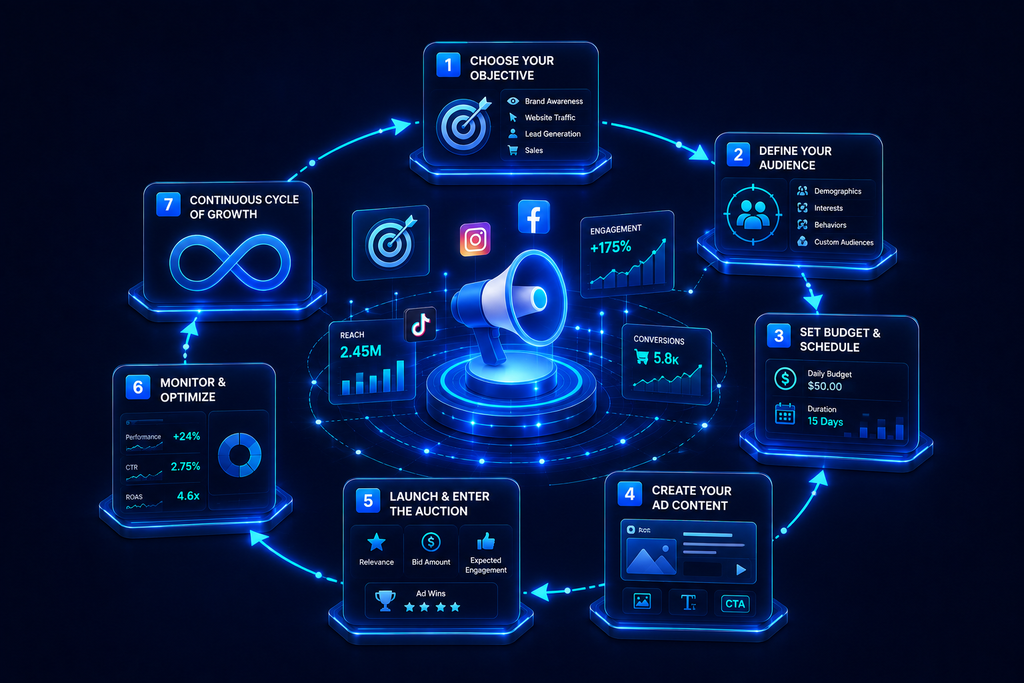
Understanding what is social media ads on a conceptual level is useful, but knowing how the mechanics work will help you make smarter decisions. Here’s a simplified breakdown of the process:
- Choose your objective. Every campaign starts with a goal, such as brand awareness, website traffic, lead generation, or sales.
- Define your audience. You select who should see your ads, based on demographics, interests, behaviors, or custom audiences built from your existing customer data.
- Set your budget and schedule. You decide how much to spend daily or over the campaign’s lifetime, and for how long the campaign should run.
- Create your ad content. This includes your visuals, copy, and call-to-action, tailored to the platform and audience you’re targeting.
- Launch and enter the auction. Similar to search advertising, social platforms use an auction system where relevance, bid amount, and expected engagement determine which ads get shown.
- Monitor and optimize. Once live, campaigns need ongoing monitoring, adjusting targeting, creative, and budget based on what’s actually performing.
This is social media advertising in action: a continuous cycle of testing, learning, and refining, rather than a one-time setup you can forget about after launch.
The Main Platforms for Social Media Advertising
Since this is a pillar page, we won’t go deep into each platform here, but a quick overview will help you understand where your business might get the best results.
1. Facebook & Instagram (Meta Ads)
The most widely used advertising platforms for businesses of nearly every size. Strong for e-commerce, local services, lead generation, and brand awareness, thanks to detailed targeting options and a massive combined user base.
2. LinkedIn Ads
Best suited for B2B businesses, recruiters, and companies targeting professionals by job title, industry, or company size. Costs tend to be higher, but the audience quality for B2B offers is often unmatched.
3. TikTok Ads
Ideal for reaching younger audiences with short-form, highly engaging video content. Particularly effective for brands with a strong creative or entertainment angle.
4. Pinterest Ads
A strong fit for businesses in fashion, home decor, food, and lifestyle niches, since users often turn to Pinterest specifically to plan purchases and get inspiration.
5. X (Twitter) Ads
Useful for real-time engagement, brand visibility, and reaching audiences interested in news, trends, and conversations as they happen.
Why Every Business, Not Just Consumer Brands, Should Consider Social Media Advertising
A common misconception is that social media advertising only works for consumer products, like clothing or beauty brands. In reality, service-based businesses, B2B companies, healthcare providers, and even local businesses benefit significantly from paid social, when the strategy is built around the right platform and audience.
Whether you’re a local bakery trying to build community awareness, a B2B software company targeting decision-makers on LinkedIn, or a consultant building trust through video content, social media advertising offers a level of targeting and creative flexibility that few other channels can match.
Combined with SEO and Google Ads, social media advertising often plays a unique role in the customer journey: building awareness and trust earlier on, so that by the time someone searches for your product or service directly, your brand already feels familiar.
How Much Should a Business Budget for Social Media Advertising?
One of the most common questions business owners ask is how much social media advertising actually costs. The honest answer is that it varies significantly based on platform, industry, audience size, and campaign objective.
Most platforms use a bidding system similar to search advertising, where you pay per click, per thousand impressions, or per result (such as a lead or purchase), depending on your campaign goal. A few factors that influence cost:
- Platform choice. LinkedIn tends to be more expensive per click than Facebook or Instagram, due to the professional audience and higher intent.
- Audience competitiveness. Popular demographics and interests, like fitness, finance, or beauty, tend to have higher costs due to advertiser demand.
- Campaign objective. Awareness campaigns typically cost less per impression than conversion-focused campaigns, since the latter targets higher-intent actions.
- Ad quality and relevance. Platforms reward engaging, relevant creative with lower costs, similar to how Quality Score works in search advertising.
Rather than fixating on a fixed number, it’s more useful to set your budget around a specific goal, such as a target cost per lead or a target return on ad spend, and adjust from there based on real performance data.
Getting Started: What a Business Owner Actually Needs
If you’re planning your first campaign, here’s a quick snapshot of what’s typically required before launch:
- A business profile on the platform you plan to advertise on, along with an active Ads Manager account.
- Clear campaign goals, whether that’s brand awareness, website traffic, lead generation, or direct sales.
- A defined target audience, based on demographics, interests, or existing customer data.
- Creative assets, including images, videos, and ad copy tailored to the platform and audience.
- A tracking pixel or conversion tool installed on your website, so you can measure what’s actually working.
Many business owners start by managing campaigns themselves, which is a reasonable way to learn the platform and understand your audience firsthand. But as budgets grow and competition increases, most eventually turn to a specialist or agency to manage targeting, creative testing, and ongoing optimization, since even small inefficiencies in social media advertising can quietly drain a budget over time.
Common Social Media Advertising Myths Business Owners Should Ignore
Before we wrap up, let’s clear up a few misconceptions that often confuse business owners exploring paid social for the first time:
- “Boosting a post is the same as running ads.” Boosted posts are a limited, simplified version of what full campaign tools in Ads Manager can actually do.
- “More budget always guarantees better results.” Without the right targeting, creative, and messaging, a bigger budget just means faster wasted spend.
- “Social media ads only work for younger audiences.” Nearly every age group is active on some social platform; the key is choosing the right one for your specific audience.
- “You’ll see results overnight.” While social ads can generate faster results than SEO, meaningful, consistent performance usually comes from ongoing testing and optimization, not a single campaign launch.
Final Thoughts: What Is Social Media Advertising for Your Business, Really?
So, circling back to where we started: what is social media advertising? At its core, it’s the practice of using paid campaigns on platforms your customers already use daily to build awareness, generate leads, and drive sales, backed by detailed targeting and measurable performance data.
This guide covered what is social network advertising, what is social media ads, how the campaign process works, and a quick overview of the major platforms, but this is just the foundation. In our upcoming cluster blogs, we’ll break down audience targeting, creative strategy, platform-specific best practices, and campaign optimization in much greater detail.
If you’re a business owner who’s serious about building consistent visibility and leads through paid social but doesn’t have the time or in-house expertise to manage campaigns effectively, that’s exactly where a dedicated digital marketing partner like Perform X Engine can help, turning this foundational understanding of social media advertising into a real, measurable growth strategy for your business.